



Metering vs Submetering: Key Differences Explained
2026-08-02
How To Install a Smart Water Submeter: Step-by-step Guide
2026-08-20Discovering a water leak is never pleasant, but finding one at your water meter feels even worse. We immediately picture the worst-case scenarios: substantial water damage, soaring water bills, and ongoing disruption, especially if leaks originate from the meter body, service line, connections, or valves. The problem is that determining exactly who’s responsible can feel overwhelming at exactly the worst time.
In most cases, the water utility is responsible for problems in utility-owned meters and parts of the public water service line, and property owners are responsible for plumbing and service lines on the customer side. The issue is that it isn’t always as clear-cut as this, since there isn’t a universal rule that applies. If you encounter a utility water meter leak, the first step is usually to contact the utility.
In this article, we’ll consider the responsibility for water meter leaks in more depth, as well as ways to tell if your meter is leaking and strategies for dealing with it. It’s important to note that this article provides general guidance only.
Who is Responsible for a Water Meter Leak?
According to LegalClarity.org, the water utility or city is responsible for utility-owned meters and at least part of the public water service line that falls on its side of the ownership boundary. If a leak occurs on the customer’s side, it’s usually the owner’s responsibility. However, there’s no single nationwide standard for this, so understanding specific state, regional, and local rules is essential.
It’s important to note that this article provides general guidance only. Local codes, utility tariffs, property agreements, and similar mechanisms will ultimately define responsibility in any given situation.
In many cases, responsibility can be determined by the ownership of the infrastructure, based on ownership boundaries as described in agreements or regulations. Utilities establish ownership boundaries because different parties are responsible for maintaining different parts of the water distribution system. These ownership boundaries can help determine who is responsible for various parts of the system, such as meter equipment.
For example, Denver Water’s services and information page defines the dividing point between Denver Water-owned mains and private service lines as the point where the property taps into the main, or the discharge side of the valve closest to the Denver Water-owned main.
When a leak occurs, responsibility for replacing a water meter usually falls to the owner of the meter. If the utility owns the meter, the utility replaces it; if the meter is privately owned, the owner replaces it instead. Where there’s an issue with high bills, responsibility for paying a high water bill varies. This is usually separate from meter replacement, and some utilities offer leak adjustment programs, while others hold the account holder responsible. The response varies by utility and local regulations, as well as the physical location of the leak.
Water Meter Leak Responsibility by Location
Responsibility for water meter leaks varies depending on where the leak is located. Many utilities determine boundaries and ownership according to curb stops, meter inlets or outlets, or corporation stops. Some use property lines or easements as the defining boundary. Whichever way these boundaries are determined, utility ownership boundaries are generally split between the public and private sides.
The public side contains all utility-owned infrastructure, such as public service lines and the utility-owned meter. The private side contains anything owned by the property owner, such as internal plumbing, private service lines, and other owner-installed and operated infrastructure.
A good example of this distinction is the private and public service line. The public service line is utility-owned and delivers water to the ownership boundary. A private service line is the underground pipe that carries water from the public service line to a property. Property owners are responsible for the maintenance, repair, and replacement of this line, while utilities are responsible for the public side. However, the specific boundaries vary by locality, making it difficult to determine who is responsible for leaks.
Here is a simple line diagram showing a hypothetical division between public (utility-owned and maintained) and private (owner-owned and maintained) infrastructure:
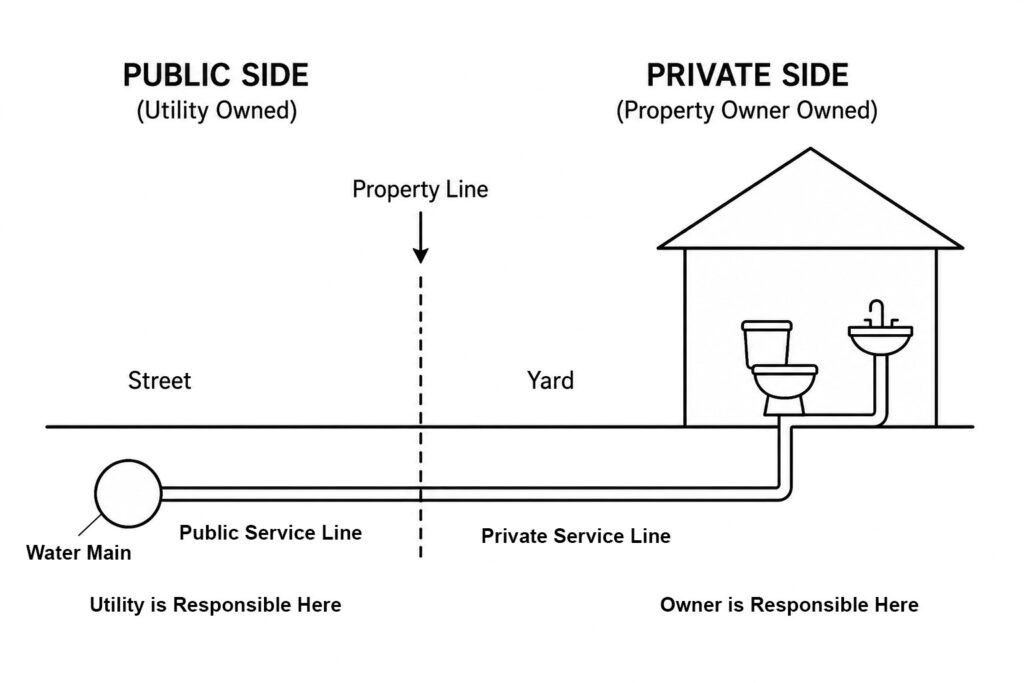
In this article, we will be discussing leaks and responsibility using the terms “before” and “after” the meter. This is a common way of discussing it, but we should first define exactly what is meant by “before” and “after”. In this context, “before the meter” refers to the public, utility-owned infrastructure such as water mains, public service lines, and utility-owned water meters. “After the meter” refers to privately owned infrastructure, such as private service lines or meters and submeters installed by the owner that do not fall under the utility company’s jurisdiction.
The following table outlines responsibilities and first actions for typical leak location scenarios:
| Leak Location | Responsibility | First Action |
| Before the meter | Often the utility | Immediately call the utility |
| Meter body | Often the utility (if utility-owned) | Do not try to fix: call the utility immediately |
| Meter connection | Depends on which side of the ownership boundary and local rules | Photograph and contact utility ASAP |
| After the meter | Often the property owner | Call a plumber if on the customer side |
| Meter box is full of water | Depends on source/reason | Check whether there is a leak or rain/groundwater ingress |
| Meter is leaking from the bottom | If the meter body is leaking, usually the utility | Immediately call the utility |
| Indoor water meter leak | Depends on ownership/service agreement | Check ownership, local rules, and call a provider or property manager |
Who is Responsible for a Water Leak Before the Utility-Owned Meter?
In many water systems and utility setups, leaks on the utility side of the service connection (before the utility-owned meter) are the utility’s responsibility. However, the exact ownership boundary differs by utility. This can be difficult to determine, since boundaries can be the curb stop, the meter itself, the property line, or any other defined point according to local rules and utility agreements.
In general, utility-owned infrastructure on the public side of the boundary will be the utility’s responsibility. In cases where responsibility has not been confirmed or is difficult to establish, customers should avoid any excavation or attempts to repair before ownership is confirmed. Utility providers should be able to verify which parts of the infrastructure fall under their jurisdiction.
Who is Responsible for a Leak After the Utility-Owned Meter?
If the leak occurs after the meter on a plumbing or service line owned by the property owner after the utility’s ownership boundary, repairs will typically be the owner’s responsibility. The exact boundary depends on local utility rules and any other regulations.
Leaks in the private service line, owner-owned irrigation systems, or building plumbing systems are typically the property owner’s responsibility. Homeowner insurance may or may not cover repairs, depending on the specific policy and circumstances.
Local Utility Rules Control Responsibility
It is impossible to offer an ironclad, universal assessment of responsibility for meter leaks, as they vary widely based on numerous factors. Ultimately, responsibility for meter leaks is determined according to local utility rules. Examples of factors influencing responsibility include:
- Utility tariffs
- Municipal codes
- State regulations
- HOA agreements
- Condominium declarations
- Leases
- Property management agreements
Across the United States, utilities operate under varying ownership structures and boundaries. While it is possible to say that, generally, utility-owned meters are the utility’s responsibility, what this means in practice differs by locality.
If you encounter a meter leak or a leak on suspected utility-owned infrastructure, the first course of action is always to contact the utility to determine the actual owner. While it can be useful to collect photographs, dates and times, and exact leak locations, it’s important not to tamper with the meter or commence any work until responsibility has been determined. This is because unauthorized tampering or damage to meters can be against contractual or agreement terms, and may be covered by local ordinances.
How to Tell if Your Water Meter is Leaking?
A leaking water meter isn’t always obvious, so it’s important to determine whether the meter itself is the problem — or if there’s an issue with surrounding connections or simply rain/groundwater ingress. Here are some methods for diagnosing a water meter leak:
- Meter inspections: Check for standing water or visible dripping around the meter box. Leaks can occur at the bottom of the meter or around connection points. A meter box that stays filled with water after draining indicates a leak.
- Smart water meter alerts: Many modern smart water meters, such as ultrasonic meters, offer advanced alert systems when leaks are detected.
- Compare water bills: A sudden, unexplained increase in bills can indicate a leak in the system. It may not specifically indicate a meter leak, but it’s a good early warning sign that one is present.
- Check water pressure: A drop in pressure throughout the property can signal a leak in the supply line or at meter connections.
Why is My Meter Box Full of Water?
When your meter box is full of water, that doesn’t automatically mean that there is a water meter leak. There are few reasons that a meter box could fill with water, including rain and groundwater, drainage problems, or irrigation runoff, that are not related to meter leaks. However, meter boxes can also fill due to leaking connections, damaged service lines, or leaking meter components.
This can make it difficult to determine exactly why your meter is filling, so it’s important to determine whether the increase is due to normal water accumulation or active leaks. The following table outlines common reasons a meter box can fill with water, and what that could mean:
| Rainwater or surface runoff | Underground meter boxes can collect water after storms, and poor drainage can make the box stay wet |
| Groundwater intrusion | Sometimes, groundwater can seep into the box, and water can appear without a plumbing leak |
| Active leaks near the meter | Leaks near the meter may be the cause of a filled meter box |
| Broken meter connections | Leaks can happen at connections rather than the meter itself, which can result in a filled meter box; responsibility here depends on the ownership of the specific broken component |
| Leaking meter body | Sometimes the meter body itself leaks, causing the box to fill with water. Often, this can be directly observed |
The following are key signs that you have an active leak, although these could also be caused by other problems:
- Water returning after being drained
- Meter movement when no water is being used
- Water is flowing from a fitting
- Bubbling or flowing water
- Sudden increases in billed usage
Who is Responsible for a Faulty or Broken Water Meter?
If the faulty or broken water meter is owned by the utility, the utility is typically responsible for maintaining or replacing it. However, this responsibility can differ depending on specific agreements and issues. When the meter or surrounding infrastructure is privately owned, such as with private meters, submeters, landlord-managed systems, and privately maintained equipment, the responsibility falls to its owner.
Who is Responsible for Faulty or Broken Utility-Owned Water Meters?
Faulty or broken utility-owned water meters are usually the responsibility of the specific water utility that owns and maintains them, and customers should not remove, modify, repair, or tamper with them.
In these cases, meter replacement and repair procedures are controlled by the utility, and the utility should be notified immediately of any issues.
Who is Responsible for Faulty or Broken Privately-Owned Water Meters or Submeters?
Typically, the responsibility for repairing faulty or broken privately owned water meters or submeters falls to the meter’s owner. However, it can be tricky to determine who is responsible for faulty or broken privately owned metering infrastructure. This can vary depending on various agreements and ownership models, e.g., HOA agreements, whether there is a submetering company with contractual responsibility for the metering infrastructure, property owners vs property management, and so on.
Responsibility for Damaged or Tampered Water Meters
Responsibility for damaged or tampered water meters is typically determined according to utility rules or local regulations. This is because a faulty or broken meter is not the same as a damaged or tampered-with meter. In some scenarios, homeowners or customers may be responsible for replacing or repairing utility-owned infrastructure. If meter damage has been caused by property work, unauthorized removal, tampering, or improper management, customers may be held liable according to local laws and regulations.
What Should You Do if You Suspect a Leak?
After a leak is found, it’s tempting to immediately attempt repairs, but this can be counterproductive. First, the problem needs to be documented and confirmed, and then the responsibility determined. If you suspect a leak, these emergency steps are a general guideline to follow to get everything fixed responsibly:
- Take Photos and Record the Meter Reading
If you suspect a leak, immediately take photos of the meter box, visible water, fittings and connections, and if possible, take a video showing active flow. Make sure to take a picture of the meter reading and always record the discovery time and date. This helps utilities, plumbers, landlords, insurers, or property managers understand the issue. - Check Whether the Leak is Before, At, or After the Meter
The location of the leak is one of the most important factors in assigning responsibility, so it’s crucial to understand exactly where it occurred. If the leak is before the meter, contact the utility immediately. If the leak is at the meter itself, contact the utility and avoid touching any meter components; do not attempt a repair or further diagnosis. If the leak is after the meter, contact a plumber or the property owner/management. - Call Your Water Utility First for Meter-Side Leaks
If you find a leak on the public, meter side of the infrastructure, immediately contact your utility provider. They can confirm ownership and responsibility, and can send personnel if necessary. - Avoid Tampering with Utility-Owned Equipment
Whether or not your meter is leaking, you should not tamper with utility-owned equipment. Do not remove, disconnect, open, or attempt to repair a utility-owned water meter unless directly authorized by the utility. Do not tamper with utility-owned infrastructure such as pipes or other connections in utility-owned areas. - Turn Off the Main Valve Only If Safe and Appropriate
If the leak appears on the private, customer side of the infrastructure and you can safely access your shutoff valve, turning off the water can help reduce damage until repairs can be made. Do not attempt to operate utility equipment or valves, as they are utility-owned and may be considered tampering. - Get a Licensed Plumber for Owner-Side Leaks
If the leak occurs on the private, customer side of the infrastructure, or on the owner’s side of the boundary, you may need to call a licensed plumber to perform repairs. - Confirm the Repair and Keep Records
Whether the repairs are performed by the utility or a privately contracted professional, you should confirm the work and maintain robust records. This can include repair invoices, communications from the utility (such as letters or e-mails), photos of the before and after states, and all dates for relevant communications and events. Take meter readings and keep any leak adjustment paperwork if offered by the utility.
Who Should Cover Water Meter Leak Repair Costs?
Who actually covers water meter leak repair costs can be quite complex, but it’s based on what failed, who owns the equipment, and what type of cost is involved in fixing it. Utilities may be responsible for repairing their utility-owned meters or infrastructure, while a property owner may be responsible for customer-owned plumbing or service lines.
It can get more complicated when secondary costs, such as property damage or unusually high water bills, are considered. These issues may be handled differently under utility rules, local laws, insurance policies, or service agreements.
Here, we’ll consider several scenarios, but it’s important to note that there is no universal answer because local agreements, regulations, and processes vary widely.
Who Pays to Repair Leaking Water Meters or Service Lines?
Typically, the utility is responsible for repairing its own water meters and service lines. If the leak occurs on utility-owned and managed infrastructure, the utility is typically responsible for paying for it. This generally means that the utility will pay to repair or replace its infrastructure and the costs associated with doing so.
If the meter or service line is privately owned, the owner will often be responsible instead.
Who Pays for Repairs if the Leak Causes Property Damage?
If a utility is responsible for the leak and the resulting property damage, assigning responsibility for the repair costs can be quite complex. Responsibility for the leak may not translate to responsibility for property repairs. Homeowners may be able to submit separate claims to the utility, but reimbursement depends on liability rules, state or local laws, and any specific agreements between utilities and property owners.
In some cases, responsibility will fall to owners, who must then pay out of pocket or submit insurance claims. There is no universal framework for payment in this scenario.
Who Pays a High Water Bill Caused by a Meter Leak?
Excessive water bills after a serious leak are a major concern for many homeowners and residents facing a leaking water meter, but there’s no clear answer to who pays for the high bills in this scenario. Like many aspects of water regulation, this is highly regional, and different localities will have different laws.
Additionally, utilities often handle these situations differently where there are no laws restricting their responses. Depending on whether the issue involves leaking meters, inaccurate meters, billing errors, or utility-side failures, the correct claims or dispute process may differ. There are two main scenarios here: paying water bills for leaks in private infrastructure, and paying water bills for leaks on utility-owned infrastructure.
Water Bills from Leaks in Privately Owned Infrastructure
This can be a highly complex situation because many utilities bill for all water that passes through a functioning meter, regardless of why. If the leak was located on privately owned infrastructure, such as internal plumbing, the cost of the wasted water often falls to the owner. This is because responsibility for the water and associated infrastructure on the owner’s side of the boundary falls to the owner. Some utilities may offer leak adjustments in this case, but this isn’t universal.
Water Bills from Leaks in Utility-Owned Infrastructure
In this scenario, determining who pays can be complicated. There is no single, universal rule across the United States. Some localities expressly protect customers when the problem is caused by utility-owned equipment. For example, the Utility Billing Manual for the City of Mercer Island, Washington, states that when leaks occur on the city’s side of the meter, the customer is not responsible for excess water charges above their historical average. However, this is highly regional, and many localities do not address this.
When facing high water bills due to leaks in utility-owned infrastructure, the most sensible course of action is to contact the utility. Customers should ask the utility to determine whether the leaking component is utility-owned, whether the meter is functioning accurately, and whether their situation is a billing dispute, a meter accuracy issue, or a utility-side equipment failure. Then, ask whether there is a claims process or other procedure for utility-caused losses.
How To Prevent Future Water Meter Leaks?
Preventing leaks is always better than dealing with them after they occur. Repairs are often more expensive, stressful, and can lead to collateral damage in other parts of the property. To reduce the risk of water‑meter leaks, consider these strategies:
- Conduct regular inspections: Inspect the pipes and meter on a routine basis. Look behind access panels, under sinks, and in other concealed areas. This approach is labor‑intensive especially in large residential communities, multi‑family buildings, or mobile home parks, but early detection can prevent costly damage.
- Watch for signs of leaks: Learn to recognize indicators such as pooling water on a lawn during dry weather, damp soil around buried pipes, or unexplained moisture near plumbing fixtures. Periodic visual checks can catch leaks early.
- Monitor water pressure: Even small drops in pressure can signal a developing leak. Regularly reviewing meter displays or pressure gauges can help you spot subtle changes before they worsen.
- Maintain infrastructure: Routine maintenance and timely servicing of pipes, valves, and related infrastructure help keep systems in good condition and minimize the chance of leaks.
- Leverage advanced technology: If you are looking for a way to improve leak detection, modern ultrasonic smart meters can detect even minor leaks in real time and send instant alerts. Mobile apps and data platforms provide actionable insights, including usage history, comparative trends, and detailed reports, to help you address issues before they escalate into major problems.
While traditional methods like inspections and monitoring are effective, they rely on consistent human attention and can be time‑consuming. Integrating advanced smart metering technology simplifies detection, automates data collection, and delivers instant leak notifications through a user‑friendly mobile application. This proactive approach helps property teams reduce water loss, improve visibility, and respond to leaks faster.