

LoRa vs LoRaWAN: Key Differences Explained
2026-01-27
LPWAN vs LoRaWAN: Key Differences
2026-02-27LoRaWAN (long-range wide-area network) is a wireless protocol specifically designed for Internet of Things (IoT) devices. It’s a low-power wide-area network (LPWAN) that enables long-distance communication with minimal power consumption. LoRaWAN connects battery-powered IoT devices with sensors, meters, and monitoring equipment to enable communication between these devices and an endpoint, often a utility or data management platform.
This article will cover everything you need to know about LoRaWAN technology: how it works, its technical benefits and advantages for users, network architecture, LoRaWAN gateways, key capabilities and characteristics, various real-world use cases, and differences between LoRa and LoRaWAN.
What is LoRaWAN Technology?
LoRaWAN is a type of LPWAN, a network type designed for wide coverage, low power consumption, and low data throughput. The core design philosophy of LPWANs is simple: it should enable large numbers of devices to connect and transmit small data packets infrequently at very low power cost.
There are multiple types of LPWAN, but LoRaWAN technology was specifically designed to address a significant problem in IoT connectivity: providing consistent, long-range wireless communication with minimal power requirements for IoT devices.
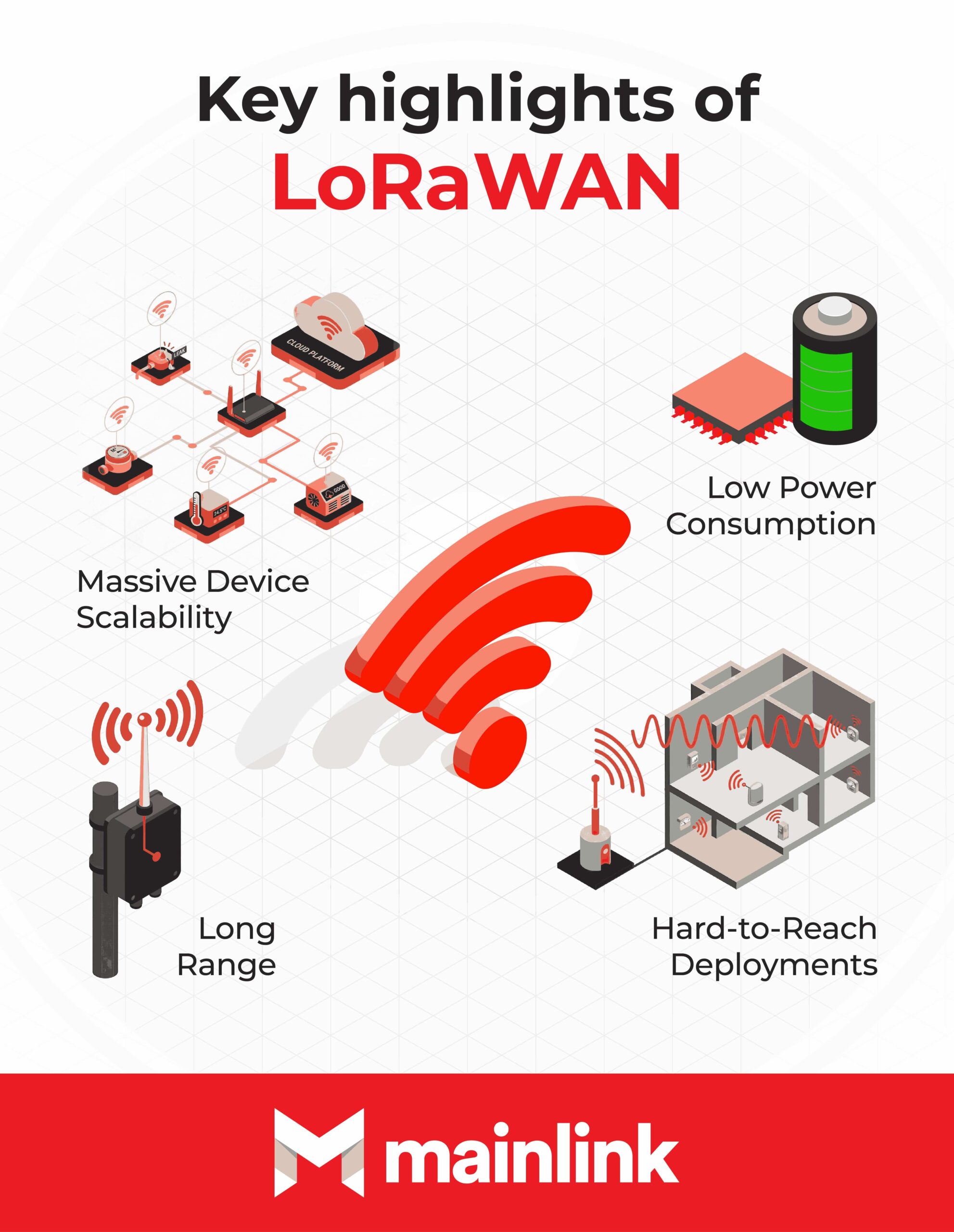
LoRaWAN’s ability to address these issues positions it as the ideal technology for use in battery-powered deployments such as those we see in water and other forms of metering. In these kinds of deployments, devices do not require constant communication and only transmit data when necessary for their operation, such as after specific events or as scheduled.
LoRaWAN is an extremely effective option for any deployment at scale, as it’s able to support thousands to millions of endpoints. Its low-power design makes it suitable for applications requiring multi-year autonomy without physical intervention, such as hard-to-access locations where human intervention is costly, inconvenient, or dangerous, such as underground sites, rural infrastructure deployments, or industrial sites.
The core design features of LoRaWAN make it an appropriate choice for a range of real-world deployments, including metering, smart infrastructure, agriculture, logistics, and long-lifecycle IoT projects.
How LoRaWAN Technology Enables Long-Range, Low-Power Communication
Although simple in concept, LoRaWAN is a technically sophisticated approach that combines long-range communication principles, low-power-consumption logic, and a design optimized for IoT use. This is achieved through clever application of radio principles and device behavior, with a physical layer provided by LoRa. The LoRa (Long Range) modulation technique defines how data is transmitted, and drives the long-range, low-power capabilities of LoRaWAN.
LoRaWAN utilizes sub-GHz bands because lower frequencies propagate more effectively over longer distances than higher frequencies. By using sub-GHz ISM bands, LoRaWAN achieves better penetration, allowing it to transmit through walls, foliage, and general urban clutter much more effectively. The LoRa modulation provides high receiver sensitivity, which allows connectivity over large distances per gateway, enabling reliable communication even when signals are very weak. This means fewer gateways are needed than, e.g., Wi-Fi or Bluetooth.
By reducing the duration and frequency of radio communication, LoRaWAN minimizes energy consumption. Devices send data packets in brief messages rather than continuous streams, resulting in less frequent transmission and predictable, brief radio usage patterns. As devices are not continuously listening, a major source of power drain is avoided, enabling multi-year battery lifetimes.
LoRaWAN’s network design aligns it with typical IoT behavior patterns, making it an effective choice for massive-scale IoT deployments. As part of its inherent design, LoRaWAN assumes low message frequency, small payload sizes, and tolerance for non-real-time delivery of data packets. These assumptions are typically how IoT deployments operate, enabling large device populations to share the same network.
By operating in unlicensed spectrums, LoRaWAN does not incur an inherent per-device licensing cost, enabling flexible deployment models. LoRaWAN can be deployed using public community networks built by shared infrastructure operators, or private networks deployed in a vast range of contexts such as campuses, factories, or utility areas. This lower barrier to entry supports adoption by municipalities, utilities, agricultural operations, and industrial businesses that need wide-area sensing without cellular-scale costs.
Thanks to its design, LoRaWAN offers license-free, long-range, low-power communications for large-scale IoT deployments by leveraging radio frequencies, low-duty-cycle device behavior, and a network designed for small, infrequent messages.
How the LoRaWAN Protocol Works
The LoRaWAN protocol, built on top of the physical LoRa layer, defines how data is organized, secured, and delivered across the network. It sits above the physical LoRa layer and controls the whole communication process. The LoRaWAN protocol is standardized and maintained by the LoRa Alliance, a non-profit organization dedicated to ensuring the success of LoRaWAN as an open, secure, global standard for low-power, wide-area networking.
As an open global standard, the purpose of LoRaWAN is to enable seamless and easy connectivity, interoperability between vendors, and flexible, consistent access to a powerful networking technology to support a vast range of deployment types.
LoRaWAN defines the communication rules between devices and the network. This ensures interoperability between vendors, simplifying deployments. LoRaWAN functions in part due to its network topology and architecture, and in part because it incorporates various protections and protocols designed to ensure network security.
Network Architecture
The network architecture is simple and effective. It’s referred to as a “star-of-stars” architecture, which is a type of hierarchical network design where multiple individual star networks are connected through a central “root” node or backbone. For LoRaWAN, this means that devices can communicate with multiple gateways, while gateways forward packets to a central network server.
Device Classes
To balance responsiveness with battery consumption, LoRaWAN networks define three device classes (A, B, and C) that determine how often a device listens for network messages. Since this is the primary driver of power consumption, it is an important factor in how LoRaWAN achieves very low power consumption.
Class A devices only listen for messages directly after they transmit, meaning the network can send data to them at only these times. In this way, the device controls the timing of communication. This results in the lowest power consumption and therefore the longest battery life, but can delay downlink communications. Class A devices are commonly used in metering.
Class B devices add scheduled reception windows, allowing the server to send messages at predictable times. This provides more controlled downlink opportunities than with Class A, but does incur a moderate additional power cost.
Class C devices keep their receivers on almost all of the time, except when they are directly transmitting. This enables near-immediate downlink communication at the cost of significantly more power consumption, making them unsuitable for battery-powered devices.
This tiered model enables LoRaWAN to support ultra-low-power sensors and near-real-time control devices within the same network architecture, increasing the protocol’s overall versatility and flexibility and offering users more deployment options.
Network Security
For network security, LoRaWAN implements several standard security mechanisms, such as AES-based encryption, unique device keys, and separation between network and application layers. It also determines which devices may join the network and require authentication, helping protect against unauthorized access and data interception.
Encryption protects data packets so that even if they are intercepted, they cannot be decrypted, while device authentication ensures that only properly authenticated and approved devices can join the network. Separate security keys for the network and application sessions ensure that network operators cannot read application data, and messages cannot be forged or altered.
Key Characteristics and Capabilities of LoRaWAN
LoRaWAN offers significant advantages as an LPWAN due to its feature set and robust capabilities. For most deployments, these key characteristics are communication range, battery life, data rate and payload size, scalability, and reliability and network resilience. While some characteristics, such as battery life and communication range, have easy-to-understand implications, others, such as data rate or reliability and resilience, are less simple.
Data rate and payload size can be broadly understood as the volume and speed of data transmission supported by the network. This has massive implications for power consumption and for the most suitable uses of the network. For example, low-power networks are unsuitable for continuous video streaming.
Reliability and network resilience is an essential characteristic for LoRaWAN networks and refers to the network’s ability to maintain successful communications even in challenging conditions, such as at long distances or due to disruptions in device functioning. Broadly, a more reliable and resilient network delivers messages more consistently, even under adverse conditions.
The table below summarises the key characteristics, capabilities, and practical implications of LoRaWAN at a glance:
| Characteristic | Implications for Practical Deployments | |
| Communication Range | Strong signal penetration 10-16+km range in rural areas 5km range in urban areas | Wide area coverage reduces the number of gateways required, which reduces infrastructure costs. Strong penetration enables connectivity in basements, utility vaults, and dense city environments. |
| Battery Life | Multi-year battery life, up to 16 years | A multi-year battery life minimizes maintenance requirements and site visits, making LoRaWAN an effective choice for large-scale, hard-to-access deployments such as in water metering and all kinds of remote sensing. |
| Data Rate & Payload Size | Low throughput Optimized for small, infrequent data packets | This ensures energy efficiency and network stability, but it does limit use to monitoring, sensing, and telemetry applications rather than anything more bandwidth-intensive. |
| Scalability | Massively scalable (millions of devices) A single gateway can serve multiple endpoints Network servers manage traffic and congestion | Networks capable of managing millions of connected devices simultaneously enable city- or utility-scale deployments while maintaining manageable infrastructure requirements and centralized control. |
| Reliability & Network Resilience | Multiple pathways can receive the same transmission Packet redundancy improves delivery success rates Performs well in noisy radio environments | Redundancy increases message reliability and system robustness, which is critical for smooth, seamless operations in utility management, infrastructure monitoring, and safety alerts. |
What is a LoRaWAN Gateway?
A LoRaWAN gateway is a radio access point for LoRa devices. It converts LoRa radio frequency (RF) signals into IP packets. As a radio access point, it connects the LoRa end devices (for example, a smart water meter) to the network and, ultimately, to the LoRaWAN network server. LoRaWAN gateways act as transparent bridges between wireless LoRa links and standard Internet connectivity.
The gateway sits between the end device and the network server. It doesn’t manage devices, gather data, or make application decisions; it exists solely to forward traffic from the endpoint to the network server.
LoRaWAN gateways are designed to be extremely simple and to perform three tasks only:
- Receiving LoRa radio packets
- Forwarding data to the network server
- Transmitting downlink messages
This functionality looks simple, but its hardware is incredibly sophisticated. It offers a streamlined process with few opportunities for error. The gateway receives LoRa radio packets and forwards this data to the network server. It does this by listening on LoRa channels, and whenever an endpoint (such as a smart water meter) transmits data, the gateway receives the signal, extracts the packet, and adds metadata such as a timestamp or signal strength. Multiple gateways can receive the same packet.
Then it forwards this data to the network server. Whenever the network needs to send data to a device, it selects a suitable gateway, which then transmits the LoRa downlink at the required time. Additional gateways can increase capacity without needing changes to end devices.
Most basic LoRaWAN gateways do not handle device authentication, packet deduplication, MAC commands, or routing data to applications. They cannot encrypt or decrypt application data, they do not manage device sessions, and they cannot perform mesh coordination.
Gateways are essential to LoRaWAN. Because LoRaWAN uses long-range radio, a single gateway can cover many miles or kilometers, reducing the number of infrastructure points needed for successful deployments. Many devices are served by overlapping gateways, improving reliability.
In summary, LoRaWAN gateways are multi-channel LoRa radio receivers/transmitters that forward packets between end devices and the network over an IP connection, acting as a bridge between the wireless IoT layer and the Internet.
Understanding the LoRaWAN Network Architecture and Components
In a typical LoRaWAN network, data flows from end devices towards the application server, passing through the gateway and network server as it does so. Although technically sophisticated, the basic architecture of a LoRaWAN network is simple and can be understood to consist of four main components:
- End devices
- Gateways
- The network server
- The application server
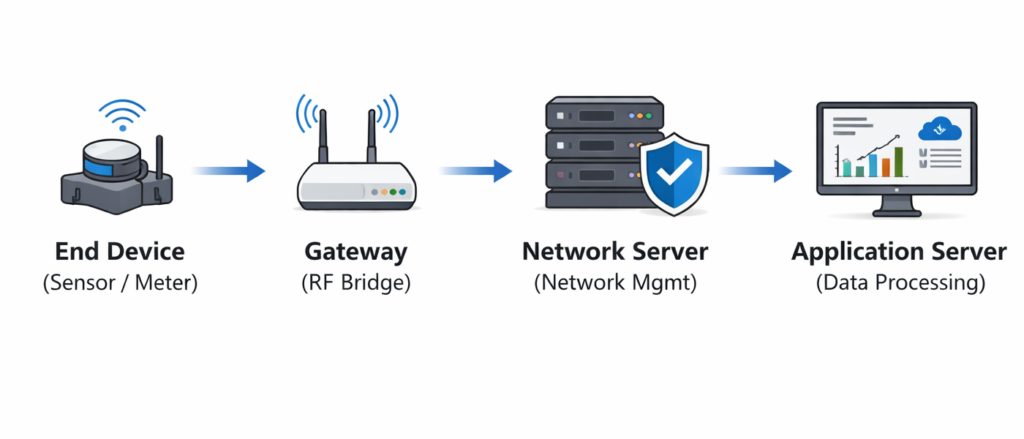
In LoRaWAN networks, end devices serve as a data origin point for the network. This is where data is collected. A typical end device is a smart meter or another type of sensor that collects data. Endpoint devices transmit their data to gateways.
Gateways serve as bridges for data, receiving it from endpoints and forwarding it to the network server. Endpoints can be heard by multiple other gateways, still it connects to LNS. Gateways exist solely to transmit or receive data and perform no other functions in the LoRaWAN network.
The network server acts as the centralized intelligence layer for the entire LoRaWAN network, managing all network-level operations. These operations include device authentication, message validation, and traffic optimization. When multiple gateways send the same data to the server, the server performs deduplication, removing any duplicates and selecting the best gateway for any required downlink responses. The network server is also responsible for security, managing cryptographic keys, preventing relay attacks, and optimizing performance through features such as Adaptive Data Rate.
The final layer of LoRaWAN is the application server, which is responsible for user-facing operations and applications. The application server decrypts application payloads and processes, stores, and presents data through dashboards, alerts, reports, and various system integrations. In a typical smart water metering setup, the application server enables remote meter reading, consumption analysis, and leak detection capabilities.
This approach enables horizontal scalability, allowing the system to grow effectively by adding more components at a given level rather than replacing existing ones. In LoRaWAN, this means additional end devices or gateways can be added without disrupting the network. This horizontal scalability enables starting with a smaller deployment and scaling to meet any emergent challenges, reducing operational and deployment complexity and cost. Gateway redundancy improves network fault tolerance, reducing single points of failure.
As network and application servers are commonly deployed in cloud environments, this enables dedicated, centralized management; API-based integrations with analytics, billing systems, and other software; and remote access and monitoring. This allows organizations to manage geographically distributed IoT assets from a single platform.
These architectural traits make LoRaWAN eminently suitable for large, distributed, and long-term IoT deployments requiring flexibility, reliability, and modern system integration.
LoRaWAN Solutions and Real-World Use Cases
As a dedicated solution to a longstanding problem in IoT deployments, LoRaWAN has been adopted worldwide across many sectors for a wide range of applications. Although a core application is smart water metering, otherwise LoRaWAN applications include the agricultural industry, smart logistics and supply chain management, and energy management.
Its flexibility and robust feature set make it an effective choice across a range of contexts, but smart water metering is a core use case that demonstrates LoRaWAN’s efficacy. In smart water metering, utilities and property owners must solve real operational challenges such as inefficient manual meter readings, significant water losses, and, more generally, inefficient resource management.
LoRaWAN-powered smart water meters and solutions enable automated and remote meter readings, reducing manual reading costs while eliminating opportunities for human error. Detailed consumption analyses can reduce inefficient resource use by promoting water conservation and better usage habits. LoRaWAN-enabled smart water meters, such as those used in Mainlink’s submetering solutions, offer advanced functionality, including leak detection, within a robust, comprehensive IoT monitoring platform.
Early leak detection is an enormous benefit to utilities and property owners. By identifying anomalies early, critical infrastructure can be repaired before they become larger problems, reducing water waste. LoRaWAN-powered smart meters can sense these early anomalies and automatically send alerts through the network, reducing the need for human detection, which is often delayed. This reduces non-revenue water while simultaneously allowing managers to allocate operational budgets and resources much more efficiently.
Why LoRaWAN is Ideal for Smart Metering
Smart metering and LoRaWAN pair extremely well. Smart metering is a core IoT use case; LoRaWAN is a protocol specifically designed to solve issues in IoT deployments. As such, LoRaWAN is the ideal protocol for smart metering requirements.
A typical smart metering IoT deployment requires:
- Devices with multi-year battery life
- Wide network coverage
- Strong signal penetration
- Low cost
LoRaWAN meets every single requirement of a typical smart metering deployment, providing significant operational benefits to districts, municipalities, utilities, and property owners:
| Characteristic | Implications for Practical Deployments | |
| Communication Range | Strong signal penetration 10-16+km range in rural areas 5km range in urban areas | Wide area coverage reduces the number of gateways required, which reduces infrastructure costs. Strong penetration enables connectivity in basements, utility vaults, and dense city environments. |
| Battery Life | Multi-year battery life, up to 16 years | A multi-year battery life minimizes maintenance requirements and site visits, making LoRaWAN an effective choice for large-scale, hard-to-access deployments such as in water metering and all kinds of remote sensing. |
| Data Rate & Payload Size | Low throughput Optimized for small, infrequent data packets | This ensures energy efficiency and network stability, but it does limit use to monitoring, sensing, and telemetry applications rather than anything more bandwidth-intensive. |
| Scalability | Massively scalable (millions of devices) A single gateway can serve multiple endpoints Network servers manage traffic and congestion | Networks capable of managing millions of connected devices simultaneously enable city- or utility-scale deployments while maintaining manageable infrastructure requirements and centralized control. |
| Reliability & Network Resilience | Multiple pathways can receive the same transmission Packet redundancy improves delivery success rates Performs well in noisy radio environments | Redundancy increases message reliability and system robustness, which is critical for smooth, seamless operations in utility management, infrastructure monitoring, and safety alerts. |
The Main Differences Between LoRa and LoRaWAN
LoRa and LoRaWAN are complementary technologies, but the difference between them isn’t a simple technical one; it has real operational consequences. LoRa and LoRaWAN operate at different layers:
LoRa handles how radio signals are transmitted over the air, whereas LoRaWAN defines how devices communicate within the managed network. A good analogy is of a physical road (the LoRa physical layer) and a traffic system (LoRaWAN). The road provides the physical infrastructure on which the traffic system operates; the same is true for LoRa and LoRaWAN.
Here’s a table summarizing the key differences between LoRa and LoRaWAN:
| LoRa | LoRaWAN |
| Physical layer radio modulation technology | Network communication protocol and system architecture |
| Encodes and transmits the radio signal | Manages how devices join the network and exchange data |
| Used in simple point-to-point systems | Uses a standardized star-of-stars network topology |
| Does not include integrated network security | Provides integrated security such as end-to-end encryption and secure key management |
| No inherent device or traffic management | Handles device authentication, message routing, and network control |
These differences matter in LoRaWAN deployments. LoRa alone does not provide a complete IoT networking solution; it lacks the standardization, scalability, and security required. LoRaWAN provides a layered approach making multi-vendor ecosystems and interoperable infrastructure feasible and accessible, even for large-scale or otherwise complex deployments.
Frequently Asked Questions
Is LoRaWan free to use?
LoRaWAN is an open standard project using a license-free spectrum. It has no recurring costs and there is no inherent subscription required, although some public networks may incur a fee. However, hardware and other LoRaWAN-related infrastructure will incur separate procurement or maintenance costs, not included in the LoRaWAN network itself.
How far can LoRaWAN transmit data?
LoRaWAN offers robust transmission capabilities, being effective over distances of up to 3 miles (approximately 5km) in dense urban environments and up to 10 miles (16km) or more in rural environments.
How secure is LoRaWAN?
LoRaWAN is a very secure protocol with security integrated into its basic design. It features end-to-end encryption, built-in authentication, and network protection.
How long do LoRaWAN devices last on battery power?
Actual battery life varies depending on device and specific deployment characteristics, but a typical LoRaWAN device offers multi-year lifespans above ten years, with some devices offering between 10-16+ years of operation.
Is LoRaWAN suitable for indoor use?
LoRaWAN is an appropriate protocol for indoor use as it offers strong penetration even in difficult indoor locations.
When should LoRaWAN not be used?
LoRaWAN is intended for low-data-throughput scenarios. It should not be used and is unsuitable for situations requiring high data rates or for real-time streaming.