


LoRaWAN Applications and Real-World Uses
2026-01-27
What is LoRaWAN? A Long-Range, Low-Power Network for IoT
2026-02-27Low-power, wide-area networks (LPWANs), such as LoRaWAN, emerged to address critical issues including poor battery life, limited range and coverage, and high communication costs in IoT applications. Traditional wireless technologies like Wi-Fi or cellular networks are often too power-hungry, costly, or complex for applications like smart metering. LoRa and LoRaWAN were explicitly designed to fill this gap. There are multiple types of LPWAN, but LoRaWAN is a popular and open global standard that is effectively employed in diverse settings and contexts.
As a result of similar names and frequent joint usage, there’s significant confusion over what exactly LoRa and LoRaWAN are, and even whether there’s any difference between them. Confusion persists due to marketing shorthand and vendors using LoRa as a catchall term, but it’s important to understand that LoRa and LoRaWAN are not the same thing. This distinction is particularly relevant for real-world deployments due to factors such as cost, scalability, and security. To quickly clarify the distinction, the infographic below highlights the core differences between LoRa and LoRaWAN.
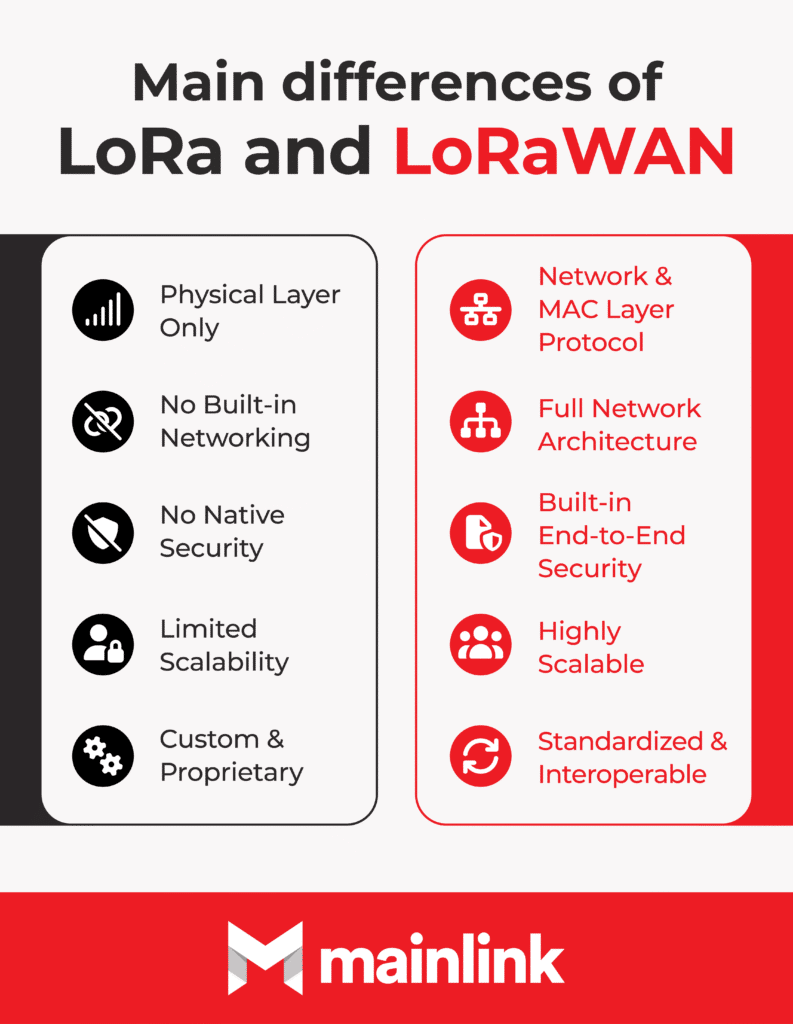
On a practical, operational level, LoRa and LoRaWAN are not equivalent concepts, and it’s important for utilities, property managers, and IoT solution decision-makers to understand the differences, use cases, and advantages of each.
In this article, we’ll discuss what LoRa and LoRaWAN are, how they differ, how they work together, and why LoRaWAN is typically required for scalable IoT solutions.
What is LoRa Technology?
LoRa means Long Range. It’s a wireless modulation technique based on Chirp Spread Spectrum (CSS). LoRa technology is designed for long-range, low-power communication between devices. It isn’t a network.
CSS enables LoRa to transmit small amounts of data over long distances using minimal energy, making it suitable for battery-powered devices that require long lifetimes without maintenance. LoRa operates at the physical layer, defining how data is transmitted, but not how devices form a network or manage communication.
LoRa’s physical layer characteristics are highly configurable, allowing system designers to trade data rate for range or energy efficiency. Parameters such as spreading factor, bandwidth, and coding rate determine things like how far a signal can travel or how resistant it is to interference. Higher spreading factors increase range and robustness, but reduce throughput, positioning LoRa as especially well-suited for small, infrequent data transmissions. Additionally, environmental factors such as urban density, building materials, and terrain can affect signal propagation, but LoRa’s ability to penetrate walls and underground structures makes it effective in metering applications.
The key features of LoRa are:
- Very low power consumption
- Long-range communication (kilometers in some settings)
- Operation in unlicensed ISM frequency bands
LoRa is typically used only for point-to-point or point-to-multipoint communication. It enables devices to send and receive data over long distances, but doesn’t define how devices authenticate, how data is encrypted, how multiple devices are managed at scale, or how data is routed to applications or the cloud. In simple terms, this means that while LoRa is a powerful, low-energy communication method, it has no built-in networking capabilities, security, or device management.
What is LoRaWAN?
LoRaWAN stands for Long Range Wide Area Network and is a network and communication protocol designed to manage device communication over long distances using the LoRa radio technology. It’s a network protocol built on top of LoRa, standardized and maintained by the LoRa Alliance, a non-profit association dedicated to ensuring the success of LoRaWAN as an open, secure, global standard for low-power, wide-area networking.
Where LoRa defines how data is transmitted, LoRaWAN defines how data is organized, secured, and delivered across a network. LoRaWAN is what enables large-scale IoT deployments.
LoRaWAN sits above the LoRa physical layer and controls the whole communication process, including device communication and network access, security and encryption, gateway-based networking, and network and device management.
LoRaWAN networks utilize gateways and cloud-based servers to move data from field devices to applications in a reliable and scalable way. In such a network, gateways act as the bridge between devices and the Internet, while cloud-based servers provide their intelligence.
So how does LoRaWAN control the communication process?
- How do devices join the network? Devices must request to join the network and provide a secure key, the server then authenticates the request. If approved, the device is allowed to join the network. This means that only authorized devices are allowed to join the network.
- How is data secured in LoRaWAN? In LoRaWAN, security is built in and operates at multiple levels. LoRaWAN utilizes AES-128 encryption to ensure that data is authenticated, encrypted, and protected from interception or tampering.
- How is data routed through gateways? Gateways, such as LoraWan supplied by Mainlink, act as packet forwarders for data. They don’t decrypt or process payload data, and any gateway within range can receive a transmission. They forward data to the network server, and the network server selects the best gateways based on signal quality and timing, removing duplicate messages and validating security. This process allows the network to remain efficient, resilient, and scalable without requiring complex routing logic on the device.
LoRa vs LoRaWAN: The Key Differences
LoRa and LoRaWAN are complementary technologies, but there are fundamental differences between them that are important to understand from an operational perspective. Here is a table showing the key differences between LoRa and LoRaWAN:
| Aspect | LoRa | LoRaWAN |
| Primary Function | Physical Layer (the radio signal) | Network and MAC layer protocol |
| Role in Communication | Wireless modulation technique using CSS | Communication protocol for managing how devices connect and exchange data |
| Scope | Typically point-to-point or simple point-to-multipoint | Full network architecture utilizing gateways, network servers, and application servers |
| Security | No built-in security: all security measures must be implemented separately | Native end-to-end AES-128 encryption and device authentication |
| Scalability | Limited scalability, as LoRa is not designed for managing large deployments | Designed for large-scale IoT deployments with thousands to millions of devices |
| Infrastructure | Direct device-to-device or device-to-receiver communication | Devices communicate via gateways connected to cloud-based servers |
| Applications | Custom or proprietary wireless links | Standardized IoT solutions such as smart metering, smart cities, utilities |
| Interoperability | Vendor-specific implementations | Flexible, interoperable ecosystem |
| Best Use Case | Simple, controlled environments with simple custom requirements | Secure, scalable, long-range IoT networks |
| Long-Range Capability | Provides the underlying long-range performance | Leverages LoRa’s range while enabling reliable, secure long-distance communication at scale |
What these differences mean in practice is that LoRa alone is much more limited than LoRaWAN. For a single simple sensor, a basic LoRa link may be sufficient. However, when networks expand to hundreds or thousands of devices, the lack of built-in security, authentication, and network coordination becomes a significant issue.
While LoRa provides the raw long-range capability used by LoRaWAN, LoRaWAN is more suitable for actual deployments that require long-range capabilities, especially at scale. LoRa provides the distance, LoRaWAN delivers the distance and operational reliability.
Is LoRaWAN more secure than LoRa?
The simple answer to this question is that LoRaWAN is significantly more secure than LoRa. There are multiple reasons for this difference in security, but the most significant reason is that LoRa does not have any built-in security features. It lacks a standardized security layer, unlike LoRaWAN.
For a more complete answer, there are four main reasons why LoRaWAN is more secure:
- Built-in AES-128 Encryption. Encryption protects data sent by the device from the moment it’s sent to the server to the moment it’s received. Even if a data packet is intercepted, it cannot be decrypted.
- Device authentication. Only properly authenticated devices are allowed to join the network, reducing opportunities for attack by preventing unauthorized access.
- Separate network and application session keys. By using different security keys for each application, network operators cannot read application data, and messages cannot be forged or altered.
- Protection against relay and spoofing attacks. Frame counters and message integrity checks enable the network server to detect and reject any replayed or tampered messages, thereby enhancing security if something manages to bypass other security measures.
Because these are core components of LoRaWAN, the protocol is much more secure than LoRa.
How LoRa and LoRaWAN Work Together
LoRa and LoRaWAN are complementary systems: LoRa provides the radio signal, and LoRaWAN provides the rules, structure, and intelligence that enable large-scale IoT deployments. LoRa is a physical layer technology, and LoRaWAN is a MAC and network layer protocol. It may be helpful to think of LoRa as the road and LoRaWAN as the traffic system, as the road (LoRa) provides the physical infrastructure for the traffic system (LoRaWAN) to use.
This layered approach is essential because it simplifies complex communication by separating it into manageable and independent layers, each with a specific job. This design allows greater modularity, flexibility, scalability, and easier troubleshooting. This design facilitates the addition of new features, the utilization of diverse hardware from different vendors, and simplifies the system’s design and management.
The division of responsibilities means that LoRA devices remain simple and energy-efficient, offloading more complex functions and processes to other parts of the system. The end devices only need to collect and transmit data: LoRaWAN takes on the responsibility of coordinating transmissions, managing device behavior, and enforcing network and security policies at the server level. This approach enables infrastructure reuse and flexibility, as the same LoRa-enabled devices can operate across different private or public LoRaWAN networks without modification.
Decoupling radio performance from network intelligence allows deployments to scale, evolve, and integrate with cloud platforms without losing the long battery life and range provided by LoRa. In effect, LoRaWAN transforms raw radio communications into a fully managed IoT network capable of managing many devices at once. It provides LoRa with the capabilities required for modern, real-world IoT deployments and applications.
Can you use LoRa without LoRaWAN?
It’s possible to use LoRA without LoRaWAN, but it’s much more limited than using LoRa with LoRaWAN. For simple, closed systems with custom firmware and infrastructure, using LoRa alone can be a viable option. This is very context-dependent, and although it is possible, most organizations choose to use LoRaWAN instead. This is because LoRa-only approaches have increased development burdens and challenges, along with a lack of interoperability and difficulty in scaling deployments.
LoRaWAN offers reduced complexity, built-in security, and ecosystem support, making it a more effective choice than LoRa alone for most applications. The difference between a combined approach and a LoRa-only approach is significant: a combined approach offers reduced development effort, standardized tooling, certified devices, vendor and integrator support, and alignment with industry standards.
LoRaWAN Architecture
LoRaWAN connects physical devices to cloud applications using a layered, star-based architecture designed for large-scale IoT deployments. In this setup, end devices do not talk directly to the cloud, and intelligence is centralized rather than distributed. This simplifies the process by avoiding complex routing or mesh networking. This cost-effective, energy-efficient design is why LoRaWAN is well-suited for large-scale IoT deployments.
There are four core components necessary for understanding LoRaWAN architecture: end devices, gateways, the network server, and the application server. Each of these core components has a clearly defined role in the process.
Let’s consider the four components of LoRaWAN architecture in more detail.
End Devices (Sensors/Meters)
End devices are the data origin point for the network. This is where data is collected. End devices are typically battery-powered and designed for low data throughput with a multi-year operational life. They collect measurements and transmit data packets at defined intervals or after specific events.
Common examples are water meters, where power efficiency is prioritized over bandwidth.
Gateways
Gateways are the bridge between LoRaWAN end devices and the Internet. They take LoRa transmissions from nearby end devices and forward them through the network, but they don’t decrypt or process data. A single device may transmit its data to multiple gateways simultaneously, improving reliability and coverage. Additional gateways increase capacity without requiring changes to end devices.
Network Server
The network server is the central intelligence layer for LoRaWAN, managing network-level operations, including device authentication, message validation, and traffic optimization. When multiple gateways forward the same message to the server, the network server removes duplicates and selects the best gateway for any required downlink responses.
It also enforces security, manages cryptographic keys, prevents replay attacks, and optimizes performance using features such as Adaptive Data Rate.
Application Server
The application server is the user-facing layer. It decrypts application payloads and processes, stores, and presents data through dashboards, alerts, reports, and system integrations. In smart water metering, this layer enables remote meter reading, consumption analysis, and leak detection.
By keeping devices simple, gateways light, and intelligence centralized, LoRaWAN enables scalable, secure, and energy-efficient data collection from thousands to millions of devices at once, supporting long battery life and reliable operation in large IoT deployments.
Use Cases of LoRaWAN in IoT
LoRaWAN is commonly used in various settings and contexts as it is a versatile technology well-suited to any use case requiring low-power, long-range, scalable protocols. For any use case with distributed assets, infrequent data transmission, and long device lifecycles, LoRaWAN is an effective choice.
Typical LoRaWAN applications include:
- Smart Water Metering. Smart water metering is the most prominent and mature use case for LoRaWAN. Often, water meters are installed in difficult-to-reach locations, making frequent readings inconvenient or cost-prohibitive. LoRaWAN enables long battery life and reliable, remote data collection at scale, and low-power alerts such as leak detection or abnormal usage alerts, making it a cost-effective choice.
- Smart Water Metering. Smart water metering is the most prominent and mature use case for LoRaWAN. Often, water meters are installed in difficult-to-reach locations, making frequent readings inconvenient or cost-prohibitive. LoRaWAN enables long battery life and reliable, remote data collection at scale, and low-power alerts such as leak detection or abnormal usage alerts, making it a cost-effective choice.
- Energy Metering. Electricity, gas, and heat meters often utilize LoRaWAN for secure data transmission and periodic consumption reporting.
- Agriculture. LoRaWAN is increasingly used in agriculture due to its extensive geographic coverage and low-maintenance, low-power nature, particularly in remote fields. Typical applications include soil moisture sensors, weather stations, and irrigation control systems, enabling data-driven decisions and optimized resource usage.
- Logistics and Asset Tracking. LoRaWAN supports tracking of containers, equipment, and other high-value assets. Its long battery life and wide-area coverage make it perfect for location updates and condition monitoring.
- Smart Cities. LoRaWAN supports smart city infrastructure such as smart parking, street lighting control, and waste management sensors. Municipalities benefit from city-wide coverage, limited infrastructure requirements, and cost-effective scalability, improving operational efficiency.
These examples represent only a portion of LoRaWAN’s use cases. As a flexible and scalable technology, LoRaWAN supports diverse applications where long-range connectivity, low power consumption, and centralized network intelligence are necessary.
Why Understanding the Difference Matters
The difference between LoRa and LoRaWAN isn’t a simple technical difference; it has real operational consequences that are important to understand. The differences have real and tangible implications for cost, security, scalability, and long-term success in IoT deployments.
Confusion between LoRa and LoRaWAN often manifests during procurement or system design. Specifications calling for “LoRa-based solutions” without requiring LoRaWAN can result in fragmented systems, incompatible devices, or insecure deployments.
When LoRa and LoRaWAN are confused, it leads to incorrect architecture choices, underestimated security needs and responsibilities, and solutions that simply cannot ever scale beyond limited pilot schemes. The key differences between LoRa and LoRaWAN are most relevant when solutions are deployed at scale, so it’s essential to understand these differences and how they impact your deployments before proceeding.
For property owners and managers, the distinction between LoRa and LoRaWAN can impact operational efficiency and cost of ownership. Managing large numbers of devices across multiple sites while minimizing manual maintenance and site visits is a strong motivator for adopting a smart metering solution, and this requires LoRaWAN rather than LoRa.
For utilities, scalability and reliability are vital features. Often, deployments require thousands to millions of endpoints for mission-critical data collection, which simply cannot be achieved by LoRa alone. This is in addition to consumer data protection. LoRaWAN offers this scalability and security through a production-ready architecture for metering networks, thereby simplifying the process.
When attempting to integrate an IoT system, LoRa introduces inherent risks and challenges related to interoperability and simplicity of integration. For scalability, simplicity, and interoperability, LoRaWAN is the preferred choice.
LoRaWAN enables secure deployments, reduces operational costs, and supports future-proof scalability. Understanding the differences between LoRa and LoRaWAN is crucial for effectively leveraging LoRaWAN’s flexibility and efficacy in a successful IoT deployment.
Conclusion
LoRa and LoRaWAN are complementary technologies, but they perform very different functions in practice. LoRa is the physical radio layer, whereas LoRaWAN is the network and communication protocol. LoRa enables transmission, but LoRaWAN enables secure communication, network management, and large-scale deployments. It transforms radio links into efficient and effective operational systems. LoRaWAN is a practical choice for utility management, smart water metering, and any large-scale, distributed IoT system, as it’s reliable, secure, and cost-efficient even at scale.
With growing adoption across various industries, LoRaWAN is a practical global standard that underpins essential processes in a wide range of contexts. Understanding the role of LoRa and LoRaWAN is crucial for successful IoT deployments, and when used in conjunction, LoRa and LoRaWAN provide a stable and scalable foundation for future growth.


