

What’s Driving Resident Complaints About Water Bills?
2026-04-09
What is NB-IoT? Technology, Network Architecture & Use Cases
2026-05-04In multifamily properties, it’s easy to understand how much water the building or property as a whole consumes thanks to the utility-owned water meter, but this provides no granular data on individual unit or apartment-level consumption. Without visibility, multifamily property owners often end up paying the whole water bill, have little understanding of unit-level consumption, struggle to identify leaks inside individual units, and cannot fairly allocate costs to the tenants who generate them.
This matters when set against a context of rising water costs as a result of increased demand, climate pressures, aging infrastructure, and inflation, as identified by the EPA’s Water Affordability Needs Assessment. As a result, many are turning to multifamily submetering systems, in which individual unit water submeters are installed that record individual unit-level water consumption and can feed this data into a centralized management and billing platform.
Water submetering systems offer numerous benefits to property owners and tenants, including better visibility, greater tenant accountability, and substantial reductions in overall water consumption — the National Multiple Family Submetering and Allocation Billing Program Study showed that direct metering can reduce annual water consumption by 15%, while other public-sector and industry analyses suggest up to 30% reductions. Leak detection, better utility cost control, and higher NOI offer additional benefits to submetered properties.
Rollout costs and provider selection can be large concerns for many property owners, but multiple provider and deployment models exist across the industry, enabling flexible, tailored approaches. In this article, we’ll discuss how submetering works, different types of providers, how to implement water submetering, benefits and challenges, costs, differences between submetering and traditional allocation methods, and whether submetering is worth it — and when it isn’t.
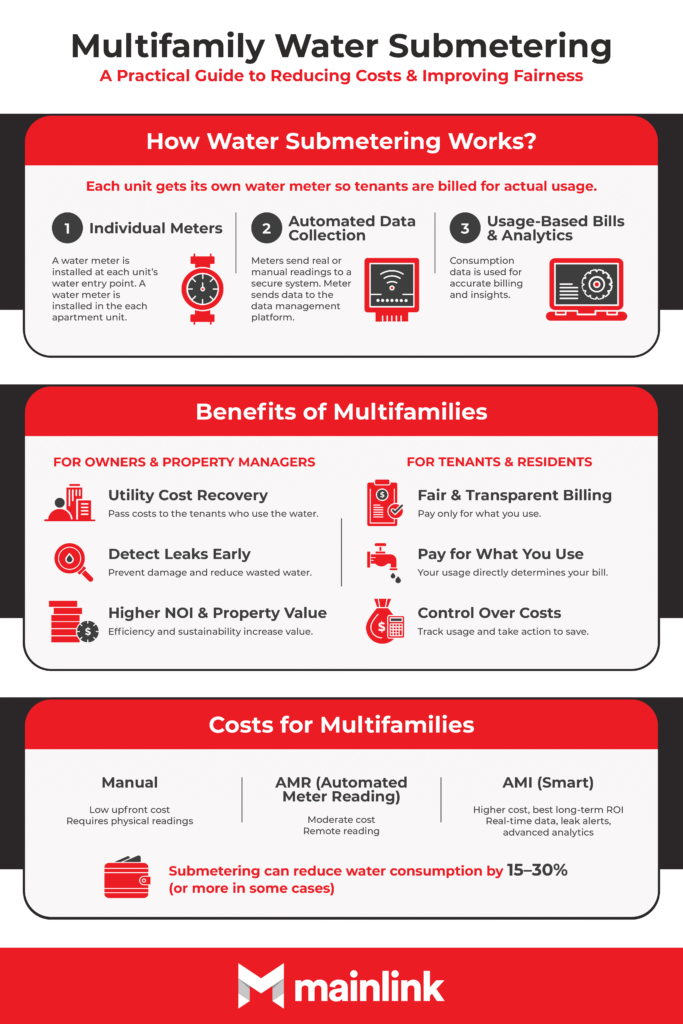
What is Multifamily Water Submetering?
Multifamily submetering is a system in which each unit in a multifamily property is equipped with its own water meter that tracks water flow independently of the building’s master meter. This means tenants are billed for their actual water consumption rather than estimates or formula-based allocations. This is fundamentally different from traditional master metering, where a single meter measures consumption for the entire building, and costs are split or allocated by a formula.
Multifamily water submetering enables multifamily home water management services connected with a utility to track consumption at a much more granular level, providing fair billing and transparent cost allocation for tenants while also supporting compliance with local or regional regulations.
How Does Multifamily Water Submetering Work?
Modern multifamily water submetering is a simple and easy-to-understand process. It works much like traditional master metering, but at a much more granular scale. The main difference is that each unit is metered separately, allowing it to be billed individually. There are three important differences in submetering versus traditional metering: meters, data collection, and billing processes.
Individual Meters per Unit
In a typical multifamily metering setup, each unit is supplied with its own water sub-meter. This means individual water meters for apartments, units, or condos are installed at each unit’s water entry point. Modern systems use a range of meters, from more traditional mechanical water meters to innovative ultrasonic smart meters, to measure water flow. Many smart water meters offer advanced features such as automatic leak detection and mobile app for monitoring and alerts.
Data Collection
Traditional submetering systems require manual meter readings. This means physical meter inspections, which can be labor-intensive and error-prone. However, many modern water submetering solutions are IoT-enabled smart systems with significant automation. These enable fully automated, remote meter readings, reducing the need for physical inspections and improving data collection efficiency and reliability.
Billing Processes & Analytics
In submetering solutions, data is usually aggregated into utility management platforms designed to collect it and support data for billing. These usually include tenant usage dashboards, detailed data for landlords and managers, and can be integrated with billing platforms other property management software.
Modern submetering systems provide substantial additional capabilities compared with older systems, including real-time monitoring, leak detection and automated alerts, device and network monitoring, full property visibility on usage analytics.
Benefits of Multifamily Water Submetering
Water submetering offers significant benefits for both landlords and tenants, whether these are financial, operational, or satisfaction-related. Key advantages include utility cost recovery, improved billing fairness and transparency, leak detection, reduced water consumption, and increased property value and marketability.
Utility Cost Recovery
Under traditional master metering systems, many landlords charge tenants a fixed price or rate for water that often bears no relationship to actual water consumption. This can leave property owners facing substantially higher costs. Water submetering allows property owners to reduce their utility expenses by passing the costs directly to the tenants who generate them.
Reduced Water Consumption and Waste
Water submetering can significantly reduce total water waste and consumption, primarily by incentivizing behavioral changes. Tenants’ bills are directly tied to their own water consumption, so they are incentivized to conserve water. The National Multiple Family Submetering and Allocation Billing Program Study shows that water submetering can reduce total water consumption by 15%. In one California community, Mainlink’s submetering solution unlocked $17,000 in monthly savings.
Improved Billing Fairness, Accuracy, and Transparency
Disputes over water bills are a common cause of landlord-tenant friction in multifamily properties. Modern submeters provide extremely accurate measurements, allowing landlords and tenants to be confident that consumption data is accurate. When tenants understand that they pay only for what they use, and their consumption data is transparent and easily accessible, fewer disputes arise, and those that do can be resolved much more easily.
Leak Detection and Property Damage Prevention
Smart water submetering systems can detect continuous flow anomalies such as toilet leaks much earlier than manual detection. Such early detection can reduce water damage costs by thousands per incident, allowing landlords to optimize maintenance budgets and direct resources where they are needed most.
Increased Property Value and Marketability
Properties with modern multifamily water management solutions and other energy-saving and sustainability measures are much more attractive to investors, as these systems deliver a significant improvement in NOI. Some tenants prioritize properties with existing water or energy-saving measures, while others will be more attracted to properties that allow them better control over their own utility expenses.
Data-Driven Insights
Detailed consumption data and statistics provided by modern water submetering systems allow landlords to better optimize their operational budgets.. Comprehensive analytics and data can help owners plan maintenance, budget for infrastructure upgrades, and target resources where they can be used most effectively. Most importantly they have access for full visibility of their properties.
How to Choose a Multifamily Water Management Solution
Selecting the right management solution for your unique context is essential, as submetering systems are not interchangeable. The system chosen directly impacts ROI, tenant satisfaction, and operational efficiency. As such, there are several essential factors to consider before making any choice. By assessing your needs in each of these areas, you can better evaluate vendors, systems, and technologies.
Types of Multifamily Water Submetering Systems
The water submetering industry has seen rapid growth and diversification over recent years, offering landlords and property managers multiple options. There are three types of water submetering systems in use: manual systems, which are traditional meters; automated meter reading systems, which don’t have advanced features; and advanced metering infrastructure, otherwise known as “smart” submetering systems with advanced monitoring opportunities.
Manual Submetering
Manual submetering is the most basic and traditional type of submetering. It requires physical meter readings, but offers the lowest upfront costs. However, manual submeters are prone to clog and their accuracy degrades over time. These meters require constant maintenance or replacements. Meter readings are typically performed by a technician or property manager, which can also increase overall metering costs.
AMR (Automated Meter Reading)
AMR systems offer wireless data collection, but without advanced features such as leak detection. They’re moderately expensive compared with manual submetering systems, but are more efficient, and are a much more modern approach to metering than traditional systems. They offer reduced labor because of the remote readings, improved accuracy, and easier data collection when compared with traditional systems, making them an attractive option. It is important to understand that AMR system usually have a mechanical meter and transmitter installed next to it to collect data. This means – more hardware costs, more on installation and maintenance.
AMI / Smart Submetering Systems
Fully smart AMI systems offer almost-real-time monitoring and data collection alongside advanced capabilities such as leak, freeze, burst, backflow detection. These systems could have higher upfront costs, but also the best long-term ROI. Because they offer comprehensive features for utility management, AMI systems are increasingly popular with building owners and managers.
AMI systems offer:
- Real-time data
- Alerts
- Enhanced analytics
- Two-way communications
- Integrations with other smart infrastructure
- Simplified maintenance
How to Submeter Water in a Multifamily Building?
Implementing water submetering in multifamily buildings is a multi-step process that requires technical evaluation, technology selection, and operational planning. A well-planned implementation can ensure accurate billing, long-term reliability, and a strong ROI. If you have opted to work with a trusted and experienced provider, your provider should be able to offer tailored advice specific to your implementation.
These six steps are an illustrative example of how to submeter water in a multifamily building:
Step 1: Assess Property Infrastructure
The existing plumbing layout needs to be assessed to evaluate the feasibility of any retrofits. Some plumbing systems may be incompatible with some meter hardware due to complexity or accessibility issues. Understanding your system layout is crucial. This includes understanding how each unit is supplied with water. Assessments should cover the number of submeters required, likely meter locations, whether there are any shared lines, the layout of hot/cold lines, and evaluate accessibility and access for maintenance and replacements.
This step is crucial because every multifamily building is different, and no submetering deployment will be exactly the same as another. Understanding the existing infrastructure and evaluating your requirements can help identify problems and challenges before they arise.
Step 2: Selecting Meter Technology
Your choice of meter technology can have material impacts on how you implement submetering in multifamily contexts. At this point, it’s important to consider exactly what you need from your submetering system.
Manual submeters are often simple to install, as they do not require complex communications infrastructure, but lack the advanced functionality found in AMR or AMI (smart) systems. All meter technologies have advantages and disadvantages.
If you have opted for a submetering service or a full submetering system provision model, your provider will generally have preferred hardware and technologies, but you can always discuss your needs with them.
Step 3: Communications and Networking
When implementing smart submetering systems, you will require a sufficient communication network. Your solution provider can help with this stage, as each implementation differs, but it typically involves purchasing and deploying components such as gateways and receivers. Depending on the specific technologies chosen, this can involve wired systems or flexible wireless infrastructure, e.g. LoRaWAN gateways or cellular receivers.
Step 4: Installation and System Setup
Installation and system setup are best done by a qualified, certified professional. Many plumbing systems are complex, especially in retrofit projects, as they were typically not designed with submetering in mind. Submeters should be fitted at the unit’s water entry point. AMR and AMI solutions will require additional system configuration, testing, and validation. A key aspect of any installation is to minimize the disruption caused to tenants.
After installation, the system should be commissioned. This includes device registrations, initial readings and checks, communications testing, and data validation.
Step 5: Billing Setup and Tenant Communication
Before switching to any new system, tenants should be clearly informed of any changes. This helps with tenant satisfaction but may also be a regulatory requirement. Always ensure that your new submetering system is both compatible with and integrated into your existing billing systems and platforms, if any.
Billing software should be correctly configured to ensure that each unit is associated with the correct submeter, all submeters are reading correctly, and that all fees being applied are correct.
Step 6: Monitoring, Maintenance, and Optimization
After a successful installation, it’s important to continue monitoring the system. This is essential for detecting leaks and tracking performance. Data-driven insights can help landlords optimize water usage, target maintenance budgets more effectively, and maintain system efficiency over time.
How to Communicate Water Submetering Changes to Tenants?
Poor tenant communication can be a major source of tension before, during, and after any water submetering implementation, so it’s essential to provide tenants with sufficient information about this process.
Before implementation, tenants should be told:
- What is changing
- Why it is changing
- When it will happen
- How changes affect rent
- How changes affect water billing
- What new charges, if any, are permissible under the law
- What the new water bills look like with an example bill
- Where the new submeter is
- What the submeter measures
- How the dispute process works, along with any adjustment mechanisms
- How data privacy works
- How leak alerts work
- Who to contact for support
Some jurisdictions may have additional regulations governing water submetering and tenant communications. It’s essential to understand all state and local regulations before implementing a solution.
Costs of Multifamily Water Submetering
A common concern from building owners and landlords is the overall cost of water submetering. Deployments can vary considerably in cost depending on unique operational requirements, specific practical conditions, and the chosen system. As such, every deployment is unique and incurs its own set of associated costs.
As an illustrative example, we can consider a 200-unit California apartment building and compare the hardware and installation costs for Mainlink’s full submetering solution with those of a typical traditional hardware solution across two deployment scenarios.
A typical mechanical installation can look like this:
- Meters (200 hot, 200 cold): $37,000
- Transceivers (400): $32,000
- Repeaters (6): $2,400
- Remote meter displays (200): $25,000
- Gateway (1): $2,100
- Labor: $54,000
- Total costs: $152,900
The costs of Mainlink’s smart submetering solution can look like this:
- Meters (400 ultrasonic): $70,000
- Gateways (2): $3,000
- Labor: $30,400
- Total costs: $103,400
These costs are an illustrative estimate based on a hypothetical 200-unit California apartment, and actual implementations will vary depending on local factors. These examples don’t include additional costs such as taxes, plumbing changes, tenant communication, billing setup, or costs incurred from property-specific challenges.
You can use this simple calculator for property managers to calculate potential costs of the smart metering system.
Across the U.S., meter hardware and installation costs vary by project, so property owners should request detailed cost calculations from their submetering partner.
ROI vs Upfront Investment Costs
The ROI on multifamily water submetering depends on the property’s water costs, installation requirements, billing structure, and ownership period. Potential financial benefits include improved utility cost recovery, lower overall water consumption, fewer leaks, and better visibility into operating expenses and NOI.
To evaluate water submetering as an investment, owners need to compare all upfront and recurring costs, including meters, installation, plumbing modifications, connectivity, software, billing, maintenance, and support, with the potential financial benefits. For example, the U.S. Department of Housing and Urban Development’s research suggests that consumption declines sufficiently under submetering to recover the system’s cost over relatively short timeframes.
A simple payback formula is:
Simple payback period = installed upfront cost / annual net benefit
The annual net financial benefit can include verified water and leak-loss savings, recoverable utility costs, and labor savings, minus any recurring submeter costs. However, actual results vary by property. Submetering may provide a strong ROI when potential utility recovery and operating savings outweigh any upfront and ongoing costs, so owners should calculate payback using property-specific data.
Multifamily Water Submetering Challenges and Considerations
Water submetering is an effective management tool with major financial and operational benefits, but successful implementation requires careful planning. The following challenges can impact feasibility, cost, compliance, and tenant satisfaction.
Upfront Capital Requirements
At the practical level, high upfront capital requirements can prevent investment. However, a holistic evaluation of the payback period, capital budgeting constraints, and financing options can make the investment more feasible.
Diverse Local, Regional, or National Regulatory Requirements
Water submetering is typically regulated at the state and local levels, with requirements that vary hugely between jurisdictions. Some states may have complex billing rules and meter accuracy standards, while others may heavily restrict the types of submetering allowed; others still may require submetering in certain types of development. The risk for owners is that non-compliance can result in fines, legal disputes, and system removals. Therefore, collaborating with an experienced, reputable provider can mitigate these risks by providing a knowledgeable partner.
Submetering rules vary significantly by state, city, lease type, property use, billing method, and tenant notice requirements. There is no universal rule or regulation governing their use, so it is essential for property owners to confirm local rules before implementation.
Retrofit Complexity
Retrofits can be considerably more complex than implementing water submetering from the ground up in a new build scenario. This can result in higher unit costs, longer installation timelines, and greater disruption to tenants. However, working with a trusted provider and experienced installers can mitigate these issues.
Tenant Pushback and Satisfaction
Many tenants used to RUBS or other allocation-based systems may be resistant to change. Common concerns from tenants include fears of higher monthly costs, perceptions of new and unfair fees, and distrust in meter accuracy. The potential for increased customer service workload due to billing disputes or poor tenant satisfaction can cause some owners to delay investment into new systems, but with clear communication and explanations of billing methodology, tenant concerns can be addressed. Many tenants respond well to the fact that they pay only for what they personally use, and access to unit-level consumption data via app or user portals increases transparency and provides clear data to help resolve disputes.
Data Privacy and System Security
Modern smart water submetering systems rely on connected systems, which introduce technical and cybersecurity considerations. Some landlords may worry about the risk of unauthorized access to consumption data, data breaches in cloud-based platforms, and system outages affecting billing accuracy. However, most modern submetering systems integrate security features into their design, and by partnering with a trusted, reputable provider that meets strong cybersecurity standards, landlords and tenants can be confident that their data is safe.
Ongoing Operational Complexity
A common concern when upgrading to a submetering system is that it introduces new operational responsibilities that property managers may not be ready for. These include monitoring system performance, managing billing cycles, or handling new types of tenant disputes. In some cases, these activities fall entirely onto property managers; in others, they can be outsourced to more comprehensive management services.
Submetering vs RUBS: What’s the Difference for Multifamily Water Submetering?
RUBS is a billing allocation method, whereas submetering is a multifamily water billing method based on actual, measured consumption. Water submetering allows tenants to be billed for actual water consumption instead of hypothetical allocated consumption under RUBS.
The problem with RUBS (Ratio Utility Billing Systems) is that costs are allocated using static formulas, such as occupancy or square footage, rather than actual water consumption. This is a problem for property owners and some tenants: property owners typically shoulder more of the utility costs, while some tenants pay for water they don’t use, and others don’t pay their fair share. While RUBS is easy to implement, it’s less effective than smart utility management solutions at recovering utility costs and reducing water costs.
Water submetering solves these problems by using individual water meters for apartments, condos, or other units. This ensures precise billing based solely on individual consumption and allows landlords to pass utility costs directly to those who generate them. Fair, transparent billing can reduce tenant disputes.
The table below summarizes the differences between RUBS and water submetering:
|
|
RUBS |
Water Submetering |
|
Billing Transparency |
Poor transparency |
High transparency |
|
Implementation |
Simple to implement |
More complex implementation |
|
Water Consumption |
No need to change behaviour |
Reductions in consumption |
|
Accuracy |
Does not track tenant water consumption |
High accuracy; actual consumption is tracked |
When Multifamily Water Submetering May Not Be The Right Fit?
Although multifamily water submetering is a practical investment in better water management tools and practices for many property owners, it isn’t a foregone conclusion. There are scenarios in which multifamily water submetering is unnecessary despite its many benefits.
Generally speaking, water submetering might not be the right fit across these six scenarios:
- Inaccessible plumbing
Complex risers or shared plumbing can make submetering difficult, as meters need to measure water supply at the unit level.
- Excessive retrofit complexity
Where existing infrastructure is complex, the retrofit requirements may prove a substantial barrier to implementation. This can include significant pipe cutting, inadequate wall or ceiling access, complex risers, substantial restoration work, too many occupied units, or other logistical problems that make installation impractical or financially difficult.
- Local regulatory issues
Local rules may restrict how water can be metered, billed, or disclosed, posing challenges for implementation. In some scenarios, property owners may conclude that water submetering is unnecessary when faced with specific local requirements.
- Water costs are already low
With low annual utility spending, water submetering may offer limited potential for savings or cost recovery, thereby resulting in a longer payback period. Some owners may be content with existing arrangements and therefore will not wish to invest money upfront into systems that won’t offer a fast ROI.
- Short-term property ownership
In some cases, owners may not expect to own a particular property long enough for the investment to make financial sense.
- Tenant relations
In some cases, implementing water submetering may pose a challenge for tenant relations. As billing changes create resident questions, potential for disputes, perception of increased rent or bills, and a need for ongoing communication or support, some owners may opt to avoid these issues entirely by avoiding submetering.
Is Multifamily Water Submetering Worth It?
The benefits of water submetering are clear and tangible: potentially significant reductions in water consumption, greater transparency and fairness for tenants, increased operational efficiency, improved NOI, and reduced maintenance costs. These are measurable financial, operational, and tenant-related benefits that make water submetering a compelling investment for property owners.
Although not suitable in every multifamily scenario, water submetering can be a financially beneficial solution for many property owners when the benefits outweigh the installation costs. A diverse industry with multiple provision models, billing and administrative support, and a wide range of technology types and implementations means there are flexible, versatile water submetering options to suit a wide range of needs.
Ultimately, successful submetering combines the right technology with the appropriate systems. For owners looking to better manage utility expenses and gain more useful data, water submetering is a valuable long-term water-management strategy that’s well worth the investment.