



Multifamily Water Submetering: How it Works, Providers, Billing
2026-05-04
LTE-M vs NB-IoT vs LoRaWAN Comparison
2026-05-26NB-IoT (Narrowband Internet of Things) is a wireless communication technology standard developed by 3GPP for cellular network devices. NB-IoT technology is an example of a Low Power, Wide-Area Network (LPWAN) protocol. LPWA networks are designed for massive IoT deployments and support low-power, low-data-rate communication at long range with deep indoor penetration.
NB-IoT networks are widely used in many types of IoT deployments, enabling reliable connectivity over large areas. As massive-scale IoT deployments become more common, power constraints, connectivity gaps, and cost at scale are becoming increasingly prevalent problems. NB-IoT is an effective solution to this massive-scale IoT problem, providing cost-effective, scalable, and long-lifecycle deployments. Common NB-IoT use cases include utilities and smart metering, smart city infrastructure such as parking management or street lighting, and various types of industrial monitoring.
This article will cover NB-IoT architecture, features, use cases, comparisons of NB-IoT vs LoRaWAN, and specific deployment considerations and challenges.
What is NB-IoT Technology?
NB-IoT is one of the most widely deployed cellular LPWAN technologies. Narrowband IoT is optimized for low bandwidth, low-power communications with deep coverage, and operates on licensed cellular spectra. These qualities make NB-IoT solutions an excellent choice for many IoT deployments.
The NB-IoT Standard
The first NB-IoT standard finalized by 3GPP was Release 13 in 2016; a year later, Release 14 introduced enhanced performance, lower power consumption, higher data rates, and better location accuracy. Since the NB-IoT standard was frozen in 2017, more than 90 operators in 51 countries have deployed NB-IoT networks, solidifying its status as an effective and practical international standard.
NB-IoT devices typically undergo rigorous testing and certification processes before deployment to ensure compliance with 3GPP standards. Compliance testing validates whether the devices meet the technical requirements of the NB-IoT standard. In addition to compliance testing, NB-IoT devices must pass operator certification to ensure devices integrate smoothly with operator infrastructure and that device behavior does not negatively impact network performance.
IoT deployments generally require ultra-low power consumption, extended coverage (such as deep underground or within large buildings), and low device complexity. NB-IoT is optimized for small, infrequent data transmissions and uses simplified signalling. The low device complexity of NB-IoT modules means they are significantly less demanding than traditional cellular devices such as smartphones, meeting low-power needs without sacrificing efficacy.
NB-IoT, LTE, and the Broader LPWAN Ecosystem
NB-IoT is part of the 3GPP cellular family and was designed to use existing LTE infrastructure wherever possible. Thanks to this design, it can be deployed in three different ways: in-band within LTE, in the unused edge spectrum (guard bands) of an LTE channel, or as a completely standalone deployment.
NB-IoT is part of a broader group of LPWAN technologies, each with its own advantages and disadvantages in any given deployment. Broadly, LPWAN technologies can be divided into two categories: cellular LPWAN, such as NB-IoT or LTE, and non-cellular LPWAN, such as LoRaWAN.
A defining characteristic of NB-IoT is that it relies on mobile network operators to provide its connectivity. Devices connect via existing cellular infrastructure, which removes the need to build or maintain network infrastructure and provides operator-managed connectivity with generally high reliability, although performance can vary depending on network conditions and operator configuration. This makes it effective for large-scale, distributed solutions where reliability and consistency are critical, but operator-managed networks can make NB-IoT more expensive than non-cellular LPWAN options.
NB-IoT Architecture: How the NB-IoT Network Works
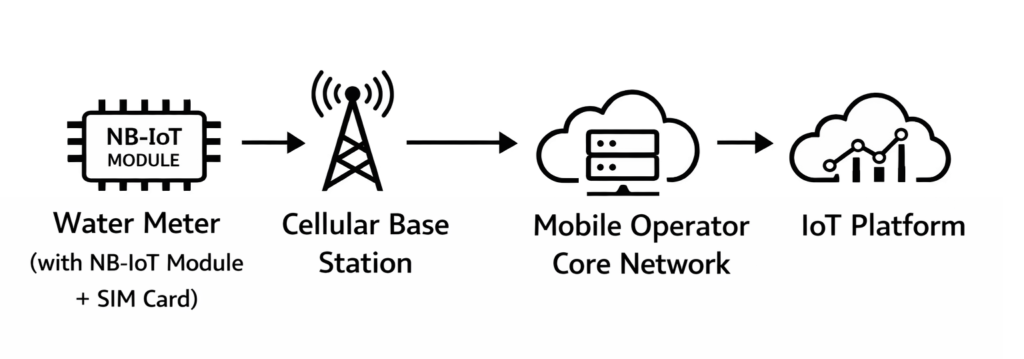
NB-IoT has a simple, effective layered architecture comprising IoT devices, base stations, and a core network (Evolved Packet Core) that manages authentication, mobility, and data routing. Each layer handles a different aspect of the process, from data collection at the IoT device to data routing from the core network.
NB-IoT Architecture Components
IoT Devices
IoT devices, such as meters, sensors, or trackers, collect data and communicate it with the base stations. IoT devices use embedded NB-IoT modules for communication. Devices utilize power-saving features such as Power Saving Mode (PSM) and extended Discontinuous Reception (eDRX) to prevent excess power consumption and allow devices to remain in a low-power state before waking periodically.
Base Stations (eNodeB)
Base stations handle wireless communication and radio resource management. They form the Radio Access Network (RAN) layer in NB-IoT deployments. Base stations are responsible for forwarding data to the core network and act as a bridge between the devices and the core network.
Core Network
The Core Network, or the Evolved Packet Core, manages authentication, mobility, and data routing through optimized protocols. This is managed by mobile operators. Utilizing SIM-based authentication, the core network handles encryption, establishes secure sessions, and is responsible for network optimization.
IoT Platforms & the Cloud
IoT platforms and cloud servers provide additional processing and functionality, such as data ingestion, analytics, and user-friendly dashboards. This layer can integrate with enterprise systems. It serves as a bridge between raw data and usable insights.
NB-IoT Data Flow
Data flow in NB-IoT follows a series of simple steps:
- Data is collected by IoT devices such as sensors or meters
- Data is transmitted via NB-IoT modules
- Data is received by the nearest base station
- Base stations route the data through the mobile operator’s core network
- Data is delivered to the cloud or application platforms
The following diagram illustrates NB-IoT architecture and data flow in a simple way:
Key Features of NB-IoT
NB-IoT is an LPWAN designed for IoT deployments. As such, its core feature suite reflects the core operational requirements of low power, extended coverage, data rate optimization, scalability, and security.
Ultra Low Power Consumption
NB-IoT devices are designed to operate on very low power for around 10 years; in some operational contexts, devices operate for more than 10 years. This makes them ideal for remote sensor deployments, such as in environmental monitoring or in utility metering.
Extended Coverage and Range
NB-IoT solves the problem of poor indoor or underground penetration in IoT deployments with its strong signal penetration, making it suitable for basements and underground meter or sensor deployments. It offers enhanced coverage vs traditional LTE options.
Low Data Rate Optimization
NB-IoT is designed for periodic transmissions of small data packets. This optimizes battery life and makes NB-IoT an efficient choice for telemetry use cases.
Massive Scalability
NB-IoT is especially well-suited for dense IoT deployments, especially in areas with good cellular coverage. It can support large numbers of devices per cell under optimized conditions, although actual capacity depends on reporting frequency, traffic patterns, and network configuration.
Secure and Reliable Connectivity
NB-IoT leverages existing cellular networks to provide cellular-grade security with SIM-based authentication.
Cost Efficiency
NB-IoT devices have lower overall hardware complexity compared with traditional cellular devices, enabling more optimized NB-IoT modules. This can lead to reduced operational costs for large-scale solutions compared with a more traditional cellular rollout.
Long Device Lifecycles
NB-IoT is optimized for low-power devices designed for continuous operation over multi-year periods, often achieving more than 10 years of continuous operation in practice. These devices require minimal maintenance, making them ideal for hard-to-access infrastructure and simplifying maintenance schedules.
NB-IoT vs Other LPWAN Technologies
All LPWAN technologies are designed to connect distributed sensor systems efficiently to provide low-power, wide-area coverage, but they differ in terms of network architecture, ownership, reliability, and scalability. Cellular LPWANs, such as NB-IoT, differ fundamentally from non-cellular LPWANs, such as LoRaWAN.
NB-IoT and LoRaWAN are popular, widely used protocols in IoT deployments, but each has distinct advantages and disadvantages across different use cases.
Spectrum Usage
NB-IoT uses a licensed spectrum, whereas LoRaWAN uses an unlicensed spectrum. This is a fundamental difference because it means the NB-IoT uses a spectrum owned and regulated by mobile network operators. This means that frequency bands are exclusively allocated, interference is tightly controlled, and performance is more predictable and stable than in unlicensed bands. However, unlicensed spectra used in LoRaWAN allow deployments without licensing fees and can be faster and easier to set up.
Network Ownership
NB-IoT networks are owned and operated by mobile network operators, whereas LoRaWAN supports both private networks owned by enterprises and public networks offered by service providers. This means that NB-IoT benefits from outsourced centralized management, service-level agreements, and carrier-grade reliability in contrast to a more ownership and control-oriented LoRaWAN deployment.
Deployment Model
NB-IoT deployment depends entirely on operator availability; it can only be used in areas where mobile carriers have rolled out NB-IoT support. This enables rapid deployments using existing network hardware and immediate access where coverage exists. LoRaWAN offers a self-deployable model, as organizations can install gateways wherever needed and extend coverage on demand, but it does require significant infrastructure investment.
Coverage
NB-IoT leverages existing cellular infrastructure to deliver wide-area coverage with strong indoor and underground penetration. This approach offers reliable connectivity; however, for hard-to-reach locations, there are still limitations, and LoRaWAN coverage is significantly stronger in deep pits and other challenging areas.
Power Consumption
Both NB-IoT and LoRaWAN are designed for low-power IoT applications and can support multi-year battery life, depending on device configuration, transmission frequency, signal quality, and operating conditions.
In general, LoRaWAN can achieve lower power consumption per transmission, especially in a well-designed private network with short telegrams and infrequent communication. NB-IoT, while also suitable for battery-powered devices, usually consumes more energy per transmission because it relies on cellular network procedures such as network attachment, synchronization, and operator-managed signaling. As a result, battery life in NB-IoT deployments can be more dependent on network conditions and operator configuration than in LoRaWAN deployments.
Scalability
NB-IoT is designed for massive IoT deployments at a carrier level. With infrastructure managed by operators, NB-IoT deployments benefit from operator-managed resource allocation and congestion control mechanisms, although performance may still be affected in high-traffic scenarios. In contrast, LoRaWAN scalability depends on the number of deployed gateways, properly planned networks and configurations, and duty cycle limitations in unlicensed bands. This means that while LoRaWAN is very scalable, it requires more careful planning than NB-IoT’s built-in, carrier-grade scalability.
Below is a table summarizing the differences between NB-IoT and LoRaWAN at a glance:
| NB-IoT | LoRaWAN | |
| Spectrum Usage | Licensed cellular spectrum | Unlicensed spectrum |
| Network Ownership | Mobile network operators | Private or public networks |
| Deployment Model | Operator-dependent rollout | Flexible, self-deployable |
| Coverage | Wide-area coverage with strong indoor penetration (operator dependent) | Flexible coverage; can achieve deep indoor penetration with proper gateway placement |
| Power Consumption | Low power, but higher energy per transmission due to cellular overhead | Very low power, optimized for small and infrequent transmissions |
| Scalability | Carrier-grade scalability via operator infrastructure | LoRaWAN: Highly scalable with proper network design (can support very large deployments) |
| Use Case Suitability | Utility metering, regulated environments, large-scale operator-managed deployments | Utility metering, smart cities, industrial IoT, private networks, rural and urban deployments where control and flexibility are required |
NB-IoT Use Cases
NB-IoT excels in applications requiring long battery life, reliable wide-area connectivity, and low data throughput. This makes it especially effective in applications such as utilities monitoring, smart city infrastructure, logistics and asset tracking, environmental monitoring, and industrial IoT.
Utility Metering
NB-IoT is widely used in utility metering applications, from smart gas to smart water. Smart utility metering solutions require an effective communications protocol, and for many implementations, NB-IoT is the perfect choice. NB-IoT enables automatic, remote data collection and transmission and supports functionalities such as remote shutoff in compatible systems. When combined with advanced metering and analytics platforms, it can support leak detection capabilities.
Smart City Infrastructure
Many city-wide infrastructure projects utilize NB-IoT to provide smart street lighting, optimized waste management and collection, and efficient parking systems. NB-IoT supports periodic data-driven city optimizations with low power consumption, although it is not designed for real-time applications requiring low latency.
Logistics & Asset Tracking
NB-IoT is an effective choice for tracking non-powered or low-power assets. It can enable great logistics and supply chain visibility using a simple and easy-to-manage system.
Environmental Monitoring
NB-IoT allows air quality sensors and flood monitoring devices to achieve low-power, reliable connectivity. It’s also an effective choice for many kinds of agricultural sensors.
Industrial IoT
In many industrial contexts, NB-IoT devices facilitate reliable connectivity as part of scalable, sensor-based NB-IoT solutions. This includes equipment monitoring, predictive maintenance, and remote diagnostics.
NB-IoT Availability and Regional Considerations
NB-IoT deployment is solely dependent on mobile network operator support and spectrum availability. If the existing infrastructure is unsuitable, NB-IoT cannot be used. The choice between NB-IoT and LoRaWAN depends first on coverage availability and then on the required deployment flexibility and business requirements. Although NB-IoT is a practical global standard, strong regional adoption trends can make deployment difficult or impossible in some areas.
NB-IoT adoption in Europe is gradually increasing, largely driven by telecom operators. However, it still lags behind LoRaWAN due to significantly higher costs. Across Europe, NB-IoT adoption is estimated at 15–20%, compared to 40–50% for LoRaWAN.
Frequently Asked Questions
NB-IoT enables automatic, remote data collection and transmission, reducing the need for manual readings or physical interventions at meter locations. This can improve the overall efficiency and accuracy of smart meter deployments while allowing for more targeted human interventions.
NB-IoT is included in the 3GPP evolution path toward 5G and can operate within the 5G ecosystem, typically anchored in LTE or integrated with the 5G core. In practice, its availability and compatibility depend on operator deployment strategies and network evolution decisions.
NB-IoT utilizes small data packets and periodic communication in addition to optimized signalling to transmit data reliably and at low power.
NB-IoT is the sensible choice when you require a licensed spectrum alongside high reliability and consistency, and when the deployment infrastructure already exists.
NB-IoT offers low device costs with subscription-based connectivity that scales efficiently; however, specific deployments will vary considerably in scale, complexity, and cost, and should be discussed with a solution provider to obtain an accurate estimate.
NB-IoT utilizes SIM-based authentication, encrypted communications, and operator-grade security. These security features make it an effective and practical choice for IoT applications.