

How To Install a Smart Water Submeter: Step-by-step Guide
2026-08-20
What is a Flow Meter? Types & Benefits Explained
2026-08-22Whether you’re a homeowner looking for a smart water meter for home use, a property manager implementing a smart water meter system, or a utility upgrading aging infrastructure, modern smart water meters provide real-time consumption data, leak detection, and remote monitoring capabilities that make metering more efficient and effective than ever before. From LoRaWAN smart water meter deployments to wired water meter solutions, today’s technology helps reduce waste and improve operational efficiency.
Water waste from leaks is a significant challenge, with the Environmental Protection Agency estimating that household leaks waste nearly 1 trillion gallons of water annually, and that up to 10% of households lose 90 gallons per day. The problem is that it doesn’t stop at waste: according to the Insurance Information Institute, water damage and freezing account for 27% of homeowner insurance losses, making them a leading cause of insured residential damage. Leaks are an expensive problem, making early leak detection a valuable investment for both residential and commercial properties.
Below, we break down the top 9 smart water meters for leak detection in 2026 ranked for accuracy, real-time alerts, ease installation, and integration with digital platforms.
1. Axioma Ultrasonic Water Meter W1
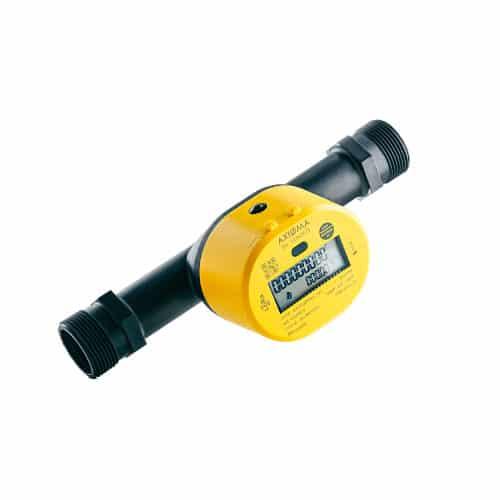
A compact ultrasonic meter, the Axioma Metering QALCOSONIC W1 stands out as a full-scale smart metering solution built for accuracy, efficiency, and long-term savings. Using ultrasonic technology and integrated LoRaWAN radio communication with options for NFC, it provides real-time leak alerts and connects seamlessly to Mainlink’s smart metering platform. It’s one of the best water leak detectors available and forms an integral component of Mainlink’s water submetering solution. The innovative ultrasonic design enables the QALCOSONIC W1 to operate at low flow rates and detect small leaks without moving parts, reducing the need for ongoing maintenance. Its 16+ year battery life, low maintenance needs, and flexible installation makes it a suitable choice for a range of metering applications.
It’s ideal for residential developments, multi-family buildings, commercial sites, and harsh outdoor environments (RV parks, manufactured housing) thanks to its IP68-rated design. With leak detection at low flow, bidirectional flow measurement the QALCOSONIC offers reliable, consistent leak detection over its 16-year battery life. The Axioma Metering QALCOSONIC W1 is engineered for durability and precision, helping property owners detect costly leaks before they cause significant damage.
Pros
- Accurate leak detection, even at low flow
- Zero maintenance – no moving parts
- Suitable for both residential and commercial, indoor and outdoor use
- Saves time and cost with simplified installation
- Powerful system-level integration
Cons
- It is more expensive than traditional mechanical water meters, as mentioned below.
2. Itron OpenWay Riva with Leak Sensor
The Arad Group’s Octave Ultrasonic Meter is a large-diameter ultrasonic water meter designed for bulk water measurement applications for utilities, waterworks, industrial facilities, and agricultural systems. With models designed specifically for larger pipe sizes, the Octave is an effective tool for district-scale applications rather than single-family residential smart metering.
The Octave uses ultrasonic technology with no moving parts, designed for long-term stability and reliability compared with traditional mechanical meters. The ultrasonic design reduces wear and tear and the need for costly ongoing maintenance across a large utility portfolio, supporting a long lifecycle with streamlined operational management.
The Octave offers flexible communication options, including LoRaWAN, M-Bus, Modbus, and Encoder communication, supporting a variety of deployment types depending on specific operational needs. This flexibility enables easy integration with various AMR and smart water management systems. The Octave also has IP68 submersible protection, making it suitable for deployments where dust or water ingress is a potential concern.
Pros
- Versatile for large-scale or agricultural deployments
- Long-term stability and flexible data outputs
Cons
- Designed primarily for bulk metering applications rather than residential properties
3. Kamstrup flowIQ
Kamstrup’s flowIQ is an ultrasonic residential water meter designed for smart water networks, where utilities need accurate water consumption tracking to generate billing data, support remote meter reading, and improve water-loss monitoring. This product is designed for residential water metering, using ultrasonic technology to provide accurate consumption data and advanced features such as leak alerts and burst alarms.
The ultrasonic design of this meter eliminates moving parts, a substantial source of wear and tear in mechanical meters, reducing overall and ongoing maintenance requirements. This design also supports long-term reliability and accuracy, ensuring the Kamstrup flowIQ maintains consistent functionality throughout its lifecycle.
The flowIQ uses static ultrasonic measurement technology to help reduce wear and tear and maintain long-term accuracy. The flowIQ supports multiple communication types, including wireless M-Bus, NB-IoT, wired M-Bus, and Kamstrup’s proprietary Kamstrup linkIQ. This meter provides robust alerts, including leak and burst alarms, reverse-flow alerts, tamper alerts, and low-battery notifications.
Pros
- Up to 16-20 year battery life
- Smart alarm system improves responsiveness
Cons
- Proprietary communications can sometimes limit interoperability and present challenges for third-party integrations outside of the Kamstrup ecosystem
4. Neptune MACH 10® R900i™
The Mach 10® R900i™ from Neptune is an all-in-one ultrasonic residential water meter with an integrated RF communication endpoint. It’s primarily intended for municipal utilities and residential utility metering programs rather than industrial applications or consumer-installed smart home water monitoring.
The Mach 10® R900i™ utilizes ultrasonic solid-state measurement for highly accurate, low-maintenance water consumption tracking. The ultrasonic design ensures a low-maintenance device and supports long-term reliability and accuracy, thanks to lower wear and tear than mechanical meters.
Neptune’s Mach 10® R900i™ meters are designed to function with Neptune’s proprietary R900 radio-based AMI ecosystem. This offers easy integration and more rapid deployment for utilities already utilizing Neptune infrastructure, though it can pose a challenge for organizations not already part of this ecosystem.
The Mach 10® R900i™ enables leak detection through continuous flow monitoring and provides leak-related alarms through the Neptune AMI ecosystem. It offers accuracy at low flows, extensive data logging, and freeze alerts.
Pros
- Excellent for cold climate installations
- Long data storage (96-day event history)
Cons
- Proprietary communications offer easy integration into its own ecosystem, but limit flexibility
5. Master Meter Sonata
Master Meter’s Sonata is an ultrasonic solid-state meter primarily aimed at utilities, smart water networks, and AMI deployments, replacing outdated mechanical meters in residential utility contexts. It’s designed for utilities looking to modernize infrastructure and improve data collection capabilities as part of an integrated system.
Unlike traditional mechanical meters, the Sonata measures consumption via ultrasonic waves. Ultrasonic technology enables devices with no moving parts, reducing the risk of wear and tear and extending device lifespan. This means that ultrasonic devices such as the Sonata remain accurate and reliable across their lifespan without the need for ongoing maintenance, supporting more streamlined maintenance.
The Sonata offers low-flow measurement, leak and burst pipe alarms, tamper alarms, and IoT-ready electronics. With an impressive 20-year battery life, the Master Meter Sonata offers reliable, long-term, low-maintenance operations. This meter supports IoT connectivity via Master Meter’s proprietary Allegro AMI or LTE-M / NB-IoT, enabling communication within the Master Meter ecosystem.
Pros
- Maintenance-free operation
- Optimized for residential applications
Cons
- Primarily targeted at residential rather than commercial or industrial environments
- Proprietary communications modules can impact flexibility and potential for integration with third-party systems
6. Sensus Cordonel
The Sensus Cordonel from Xylem is a static ultrasonic water meter designed for bulk and commercial water measurements. This high-performance ultrasonic meter features integrated pressure and temperature sensors for advanced network monitoring. Its lack of internal moving parts means it experiences less wear and tear than mechanical meters, reducing maintenance requirements over its multi-year lifespan and ensuring consistent and reliable accuracy and operations across its lifecycle.
The Sensus Cordonel is designed for commercial, industrial, irrigation, and district metering applications, making it a versatile utility- and infrastructure-grade meter. However, these qualities make it less suitable for smaller scale residential applications.
Its flexible installation requirements mean that it doesn’t require a straight pipe run. The Sensus Cordonel can utilize a variety of communication methods, including wireless M-Bus, the proprietary SensusRF, and NFC, and integrates easily into the Sensus FlexNet AMI system. The Sensus Cordonel has a waterproof design, making it suitable for outdoor use.
Pros
- Reliable even in harsh environments
- Real-time data collection
Cons
- Not optimized for small residential properties
7. Badger Meter E-Series Residential Ultrasonic Flow Meter
The Badger Meter E-Series Residential Ultrasonic Flow Meter is a residential ultrasonic smart water meter designed for municipal utilities and AMI deployments for residential billing. Unlike Badger’s PIPEMINDER, the E-Series is a true ultrasonic water meter that measures consumption and supports smart water management.
The E-Series uses ultrasonic solid-state technology for measurement and delivers highly accurate, low-maintenance water consumption monitoring. Compared with mechanical types, this allows the E-Series to maintain accuracy over its service life, providing long-term reliability. The Badger Meter E-Series Residential Ultrasonic Flow Meter is intended to replace traditional legacy mechanical residential meters that are still common across the United States, and has compact, weatherproof, and UV-resistant housing to support multiple deployment scenarios.
Internal data logging stores hourly consumption history, while the LCD displays consumption, flow rate, and alarm information. The E-Series Residential Ultrasonic Flow Meter integrates well with Badger Meter’s ORION and BEACON platforms for remote data collection and network management, and additional capabilities, such as pressure monitoring, are available when paired with compatible hardware. This positions the E-Series as a strong option for utilities and owners that are already part of Badger’s smart water ecosystem.
Pros
- Long-term measuring accuracy and reliability
- Strong integration with Badger’s ecosystem
Cons
- Best suited to utilities already investing in Badger Meter infrastructure
- Primarily intended for residential utility metering
8. Mueller Systems Positive Displacement Meter
Mueller Systems’ positive displacement meters combine traditional mechanical water meters with smart metering capabilities through Mueller’s AMI ecosystem. Unlike ultrasonic smart meters, positive displacement meters utilize mechanical components to measure the volume of water passing through the meter. This approach is simple and effective, but mechanical meters have many internal moving parts that are susceptible to wear and tear, which means they require ongoing maintenance.
Mueller Systems’ Positive Displacement Meters are designed for utilities that need reliable metering combined with modern data collection capabilities. When combined with Mueller’s Mi.Net AMI platform, Mueller’s Positive Displacement Meter supports remote reading, data transmission, and utility management.
These meters are typically used by utilities to modernize existing metering networks, particularly in upgrade programs designed to work with existing mechanical infrastructure. Communications depend on specific modules and Mi.Net configuration chosen; the meter hardware provides only measurement capabilities, with IoT connectivity being provided by additional AMI components.
Pros
- Proven durability
Cons
- Less accurate at low flows
- Higher maintenance than ultrasonic models
9. ZENNER Minomess A B.One
The Minomess A B.One is a single-jet dry-dial water meter with an integrated radio module. It’s a mechanical meter rather than an ultrasonic one, but it’s a smart mechanical meter rather than a traditional manual read meter. It’s available with LoRaWAN or wireless M-Bus communication and is designed for potable, hot, and service water scenarios, depending on the model.
Featuring a compact design and low overall height, the ZENNER Minomess A B.One is suitable for both horizontal and vertical installation, including on risers and downpipes. It uses a mechanical single-jet measurement approach, and its built-in radio module eliminates the need for external communication modules.
It’s intended for smart metering deployments that require remote meter reading, typically in residential and apartment metering contexts rather than distribution. Built-in smart metering functions include leakage, reverse flow, tamper, and meter stop detection, making it suitable for utilities and property owners who wish to retain traditional measurement technologies while upgrading to smart metering.
Pros
- Integrated LoRaWAN or wireless M-Bus communications
- Multiple built-in monitoring and tamper alarms
Cons
- Shorter battery lifespan than some alternatives
- Designed around residential metering rather than larger commercial applications
Side By Side Comparison of the Best Smart Water Meters
Smart metering systems differ significantly, with each one offering different features at different price points. Smart water meter price varies significantly depending on the technology, communication protocol, and intended deployment. Residential smart water meter solutions may cost a few hundred dollars, while utility-grade IoT smart water meter systems designed for large-scale deployments can cost substantially more. Cost, features, and infrastructure requirements should be balanced against the intended use case and deployment scenario.
Here is a table comparing each of the smart water meters considered in this article, with data taken from relevant product specs:
| Meter | Type | Communication | Leak Detection | Battery Life | IP Rating | Best For |
| QALCOSONIC W1 | Ultrasonic | LoRaWAN, wM-Bus, NB-IoT, NFC | Low flow detection, continuous flow analysis, leak/burst alarms | 16+ years | IP68 | Submetering, multifamily |
| Badger Meter E-Series G2 | Ultrasonic | ORION Cellular endpoints, BEACON SaaS | Flow monitoring and alarms, temperature data and alarms | 15 years | Not stated | Residential, light commercial |
| Arad Octave | Ultrasonic | LoRaWAN, M-Bus, Modbus, Encoder | Flow analytics, abnormal consumption detection, utility leak monitoring | Up to 10-12 years | IP68 | Commercial |
| Kamstrup flowIQ | Ultrasonic | Wireless M-Bus, wired M-Bus, NB-IoT, Kamstrup linkIQ | Acoustic leak detection alarms from flow analytics, reverse flow and tamper monitoring | Up to 16 to 20 years | IP68 | Residential utility |
| Neptune Mach 10® R900i™ | Ultrasonic | R900 RF | Continuous flow monitoring, leak alerts, freeze alerts | 20 years | IP68 | Municipal |
| Master Meter Sonata | Ultrasonic | Master Meter Allegro/AMI | Low-flow monitoring, leak/burst alarms | 20 years | IP68 | Residential utility |
| Sensus Cordonel | Ultrasonic | SensusRF, M-Bus | Flow monitoring, pressure/temperature monitoring, abnormal usage detection | 20 years | IP68 | Commercial, utility |
| Zenner Minimess A B.One | Mechanical, single-jet | LoRaWAN, wireless M-Bus | Leak detection, reverse flow detection, meter-stop detection, pipe-burst detection | 10 years | Not specified | Residential and light-commercial |
| Mueller Positive Displacement | Mechanical | Mueller MiNet AMI | Continuous flow monitoring and abnormal usage detection (depending on AMI endpoint configuration) | Varies | Model dependent | Budget AMI upgrades |
How We Ranked These Best Smart Water Meters?
We evaluated these smart water meters through a combination of manufacturer specifications, technical documentation, and deployment information to compare products across a consistent set of criteria. Rather than focusing on individual specifications, we considered performance in real-world utility, commercial, and residential applications.
The products were compared according to the following criteria:
- Measurement technology: Ultrasonic, mechanical, or electromagnetic design, including expected maintenance requirements and long-term measurement stability
- Leak detection capabilities: This was a prerequisite for inclusion on this list
- Communication options: We considered availability of open standards (e.g. LoRaWAN, NB-IoT) vs proprietary systems
- Deployment flexibility: Suitability for various deployment scenarios such as residential, commercial, utility, submetering, or district metering applications
- Reliability: We considered factors such as battery life, environmental protection, and overall durability
- System integration: Compatibility with AMI platforms, remote monitoring systems, and utility management software
Best Smart Water Meters for Home Use
Although utility-grade and single-family residential smart water meters measure the same things, they’re typically designed to address different needs. Residential-scale smart water meters are generally designed around homeowner features such as app monitoring, alerts, and automatic shutoffs. In contrast, utility smart meters are designed for remote meter reading, AMI integration, and large-scale water management.
Previously, we’ve covered utility-grade, professional-scale smart water metering infrastructure designed for utility, commercial, multi-family, and infrastructure-based applications. Here, we’ll discuss the top three consumer-focused smart water meters designed for single-family residential contexts.
Flume 2
The Flume 2 is a smart water monitor that attaches to an existing water meter to monitor water use via its connected app. It’s designed for homeowners who want to monitor household water consumption and receive leak alerts, but who don’t want to or can’t replace their existing water meter.
The Flume 2 offers easy retrofits without any need for replacements to utility meters, and enables quick smartphone monitoring of water consumption.
Moen Flo Smart Water Monitor & Shutoff
Moen’s Flo device is designed to monitor water pressure, temperature, and flow throughout the whole home, and can automatically shut off water. This device is designed for homeowners looking for whole-home leak protection with smart home integration.
Phyn Plus Smart Water Assistant & Shutoff
Phyn’s Phyn Plus Smart Water Assistant & Shutoff used high-definition pressure wave analysis to alert users to leaks and automatically shut off water. This is an effective single-family residential water monitoring solution designed primarily for home water protection.
Types of Smart Water Meters
Smart water meters can utilize various measurement technologies to track water consumption and flow, including ultrasonic, mechanical, and electromagnetic approaches. Each approach has its own advantages and disadvantages.
Ultrasonic Smart Water Meters
An ultrasonic smart water flow meter utilizes sound waves to measure water flow. This enables them to have no moving parts, making them less susceptible to wear and tear compared with traditional mechanical water meters. This means they can remain reliable and consistent over their long multi-year lifespans, offering high levels of accuracy throughout.
Mechanical Smart Water Meters
Mechanical meters measure water flow through moving components such as turbines or displacement mechanisms. This means their accuracy can be affected by mechanical wear over time, unlike ultrasonic meters. Many modern systems add communication modules to traditional mechanical meter bodies to create electronic water meters. Mechanical meters are often the cheapest upfront, but require ongoing maintenance.
Electromagnetic Smart Water Meters
Electromagnetic meters use magnetic fields to measure liquids and are commonly used in large water and industrial applications, such as water distribution, wastewater monitoring, and industrial flow measurement. This type of smart water flow meter does not require turbines or pistons, so offers a low-maintenance option compared with mechanical meters.
Key Differences Between Smart Meters and Traditional Meters
Smart water meters are a major step forward from traditional mechanical meters. They deliver highly accurate readings automatically, without the need for manual data collection. This means better data quality, fewer errors, and more efficient operations. In addition to improving day-to-day management, smart meters also support long-term savings and strategic decision-making. The table below highlights the most important differences between smart and traditional meters.
| Feature | Smart Meter | Traditional Meter |
| Operation | Uses innovative ultrasonic technology to monitor water flow and detect leaks | Uses mechanical gears and dials, turbines, or pistons |
| Accuracy | High, long-term accuracy | Accuracy is lower and may degrade over time |
| Maintenance requirements | Low maintenance | Requires regular maintenance and technician visits |
| Costs | Higher initial costs, lower operating and maintenance costs over time | Lower setup costs, requires regular maintenance, may incur higher costs due to inaccurate manual readings |
| Durability | Durable, with no moving parts to add wear and tear | Moving parts may become damaged over time leading to inaccuracy and poor performance |
| Data Collection | Remote monitoring, automatic data collection | Requires manual attention to collect data |
How to Choose the Right Smart Water Meter For Your Property?
Choosing the right smart water meter depends on where it will be installed, who needs the data, and what level of monitoring is required. Every deployment is different, and a homeowner looking to detect simple leaks has vastly different needs from a property manager requiring visibility across an entire portfolio or a utility managing thousands of meters across a municipal-scale network.
Homeowners
For single-family residential contexts, the core priorities are typically visibility, leak protection, and ease of use. A smart water meter for the home should provide:
- Leak alerts to identify unusual water usage or potential pipe problems
- WiFi or cellular connectivity for convenient remote access
- Mobile app support for convenient access to consumption data and notifications
- Simple installation and setup
Consumer-focused products such as Flume, Moen Flo, or similar smart water monitoring systems are designed around these needs, providing homeowners valuable insights without requiring utility-scale infrastructure.
Property Managers
Property managers typically need solutions that support multiple properties, can integrate tenant billing, support operational monitoring, and provide high-resolution data at scale. In these cases, it’s important to consider:
- Remote readings and automated data transmission to reduce human interventions and streamline data collection processes
- Open communications protocols that allow integration with any existing systems
- Long battery life to reduce ongoing maintenance requirements
- Compatibility with water submetering systems to enable individualized per-unit consumption tracking for utility cost recovery and improved billing accuracy
- Leak detection that could identify leaks at the unit level
In multi-unit buildings or properties, the ability to integrate meters into a wide management platform is often more important than customer-facing features such as app-based monitoring, but many modern submetering systems offer robust, comprehensive integrations alongside consumer-friendly apps.
Utilities
Utilities tend to have very different requirements from homeowners and property managers, as utility-grade smart meters must operate consistently, reliably, and accurately at scale. This means utilities need to consider factors such as:
- AMI (advanced metering infrastructure) technology
- Communications protocols such as LoRaWAN or other Nb-IoT
- Certifications for regulatory purposes
- Long-term reliability and support for large-scale deployment
Utility-grade meters are usually chosen based on network compatibility, operational data requirements, regulatory considerations, and lifecycle cost rather than consumer convenience features.
Why Communication Protocols Matter
Communications technology is a fundamental part of IoT smart meter deployments and determines how easily a smart water meter can connect to other systems and how flexible the installation will be in the future. The challenge of IoT connectivity in smart metering has led to multiple communication technologies, each with its own advantages and disadvantages. One practical difference between different smart water meters involves open versus proprietary communication systems.
Open systems utilize existing, open standards such as LoRaWAN. The advantages of open systems are that they enable multi-vendor compatibility, facilitate easier expansion when adding more devices, and reduce dependence on a single manufacturer. They can enable greater flexibility for organizations that want to combine equipment from different suppliers, such as in retrofit or partial upgrade scenarios.
In contrast, proprietary systems are owned, managed, and created by a specific manufacturer for use in its own product ecosystem. While this has several advantages, such as faster deployment within that manufacturer’s ecosystem, dedicated technical support, and strong hardware and software integration, it also introduces greater dependence on a single supplier. This means that future flexibility can be limited if requirements change.
Certifications
Any chosen smart meter should meet operational requirements. There are several important certifications and specifications that can be used to check this, including:
- NTEP certification in California: important for revenue-grade billing applications where approved measurement accuracy is mandated
- Local utility approval requirements: some regions require specific approvals before meters can be installed for billing or official measurement purposes
Contact Mainlink for expert guidance on leak detection, ultrasonic meters, and water submetering.
Frequently Asked Questions
What is a smart water meter?
A smart water meter is an electronic device that measures water consumption. It automatically transmits usage data to a monitoring platform, and many models also offer leak detection, burst alerts, and remote meter reading.
Are smart water meters worth it?
Yes. Smart water meters can reduce water waste, improve billing accuracy, and identify leaks before they cause costly property damage. They often deliver long-term savings that far outweigh the initial investment.
How does a smart water meter detect leaks?
Most smart water meters analyze continuous flow patterns, detect abnormal usage, pressure changes, or acoustic signals. When unusual activity is detected, the system sends an alert to property owners or utility operators.
Do smart water meters need WiFi?
No. Professional wireless water meters rely on LoRaWAN, cellular, M-Bus, or other AMI networks for data transmission and therefore do not require WiFi.