



Water Conservation 101: Why Property Owners & HOAs Need Smarter Solutions
2025-07-01
Top 9 Best Smart Water Meters with Leak Detection
2025-07-01A smart meter is a digital device that measures utility consumption such as water, electricity, or gas and transmits the data remotely. In this article, we focus specifically on smart meters for water systems. These devices automatically collect usage data, can detect leaks, and provide almost real-time insights through data management platforms or mobile apps. This makes them an essential tool for efficient water management and leak prevention.
In the sections below, we explore what smart meters look like, their size and design characteristics, and how they differ from traditional models.
What Does a Smart Meter Look Like?
Smart meters come in various shapes and sizes, but they generally fall into three categories:
- Non-integrated smart meters: These resemble traditional mechanical meters but include an external transmitter module that enables remote reading. Often used as retrofit solutions, they provide basic smart functions without requiring a full meter replacement. However, they may lack features like real-time leak detection and advanced analytics. Non-integrated smart water meters lack a digital display – instead, they look like a traditional water meter with dials and numbers that has additional device attached to it, usually a box or module connected by wires.
- Integrated smart meters: These are purpose-built, all-in-one devices that combine internal sensors, communication modules (e.g., LoRaWAN or NB-IoT), and digital displays in a single compact housing. Most integrated models use ultrasonic technology for precise, maintenance-free measurement. Integrated smart meters are an all-in-one device that includes a digital display for easy meter readings.
- Hybrid smart meters: Hybrid smart meters sit in between retrofits and fully integrated meters. They typically start as a mechanical meter (often a positive displacement or multi-jet design) but are outfitted with an encoder register or sensor module that digitizes the measurement. In essence, the meter still measures volume by mechanical means (water turning a piston, disc, or turbine inside), but instead of a simple analog dial, it has an electronic register that encodes the reading. Hybrid smart meters look similar to non-integrated smart meters: they will typically be a traditional mechanical water meter with an additional module or attachment to provide the smart functions.
Smart water meters – whether retrofitted, hybrid, or fully integrated – are changing how water usage is tracked and billed. Property owners and managers can choose a solution (for example – residential smart meter) tailored to their building infrastructure and overall needs: non-integrated retrofits to quickly modernize existing meters for remote readings and leak alerts, hybrid systems to retain the familiarity of mechanical meters while gaining digital accuracy for billing, or integrated smart meters for an advanced, long-term metering infrastructure with superior accuracy and analytics. All three approaches bring tangible improvements over manual reads or RUBS estimates.
Size and Design of Integrated Smart Meter
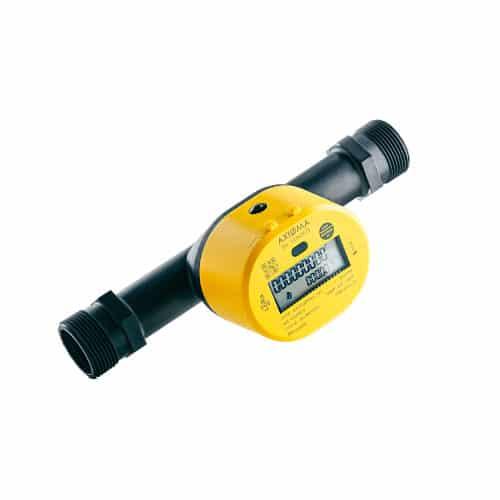
The image above shows a fully integrated smart meter, combining ultrasonic technology, data transmission, and display functionality in one compact unit.
How big is a smart water meter?
Smart meters come in different sizes, depending on the market, property type, and use case.For example, ”Axioma metering” smart meter sizes vary: 3/4, 1 and 1 1/2 inch for the U.S. market, and different sizes in the EU market.
These sizes are appropriate for almost all residential installations and purposes, bringing an effective solution in a compact, space-saving package.
Meters for commercial or industrial use may be significantly larger – up to 20 inches or more – to accommodate higher flow rates or larger pipe diameters. Despite advanced features, most smart meters are designed to remain compact and efficient in terms of space.
Smart Meters vs. Traditional Meters
| Feature | Smart Meter | Traditional Meter |
| Measurement Method | Ultrasonic or enhanced with transmitters | Mechanical (gears, turbines, pistons) |
| Accuracy | High, sustained over time | Declines with wear and debris |
| Installation Flexibility | Any angle or orientation | Limited to specific orientations |
| Data Collection | Remote, automatic | Manual, in-person |
| Leak Detection | Built-in (if integrated) | Not available |
| Maintenance | Minimal (no moving parts in ultrasonic types) | Periodic service required |
Key Features of Smart Meters
Smart meter adoption is increasing as property owners and other stakeholders become aware of its expansive and comprehensive benefits when it comes to water management. Smart meters offer a range of benefits that make them a future-proof solution for water management:
- Almost Real-Time Monitoring: Residents can view up-to-date consumption data through app, enabling better decision-making and faster response to anomalies.
- Instant Leak Detection: Ultrasonic meters detect even small leaks immediately, preventing costly water damage and improving operational efficiency.
- Ultrasonic Technology: These meters have no moving parts, making them more durable and accurate. They are also resistant to buildup from debris or minerals, which can affect traditional mechanical meters accuracy.
- Remote Data Collection: Automatic readings reduce labor and eliminate manual errors. Data is transmitted securely to the data management platform and mobile application for easy access.
- Long-Term Cost Savings: While upfront costs may be higher (depending on location, property size, building infrastructure, etc.), smart meters reduce maintenance needs, prevent water loss, and enable targeted usage reduction resulting in substantial savings over time.
- Seamless Installation:
Smart meters, especially ultrasonic ones, are easy to install, typically taking 30 minutes or less since there’s no need to install transceivers. Installation is up to twice as fast compared to mechanical meters. With Mainlink’s mobile app, installers receive instant confirmation of successful meter setup. - Scalability:
Smart water meters using the LoRa network are ideal for any type of deployment and can be easily scaled over time.
Compared with traditional water meters, smart meters are an efficient, cost-effective upgrade packed with innovative technology. They offer a comprehensive, efficient, and automated solution that reduces complexity and simplifies water management for property owners and residents.
Mainlink’s Smart Metering Solution
At Mainlink, we offer integrated ultrasonic smart meters that eliminate the need for external displays, transmitters, and repeaters. This reduces installation complexity and long-term maintenance costs. Our meters provide reliable data, empower residents through mobile access, and deliver full visibility for property owners via a cloud-based meter data management system.
Mainlink’s metering and submetering solutions provide a cost-effective solution that empowers property owners to make strategic decisions. The robust Mainhive data management platform delivers a cost-effective, fully-featured metering platform that scales well whether you need it for smaller properties or large, multifamily mobile home parks. With customizable reports, precise data for billing, and fully automated data collection, Mainlink offers a smooth user experience that’s both sustainable and scalable.
Mainlink’s user-friendly, resident-focused app allows residents to track their own usage and become full participants in the water management process. This delivers tangible benefits to both owners and residents, paving the way for enhanced collaboration and cooperation.
Final Thoughts
Smart meters are compact, intelligent devices that bring measurable value to both property owners and end users. Whether you’re managing a residential complex or retrofitting an older building, upgrading to integrated smart metering offers a high-accuracy, maintenance-free, and reliable solution with remote meter data for advanced water management.
Should you get a smart water meter? Book a consultation with Mainlink to explore how our NTEP-certified solution can meet your property’s needs.


