

AMI for Water Utilities: How Advanced Metering Infrastructure Improves Utility Operations
2026-09-17
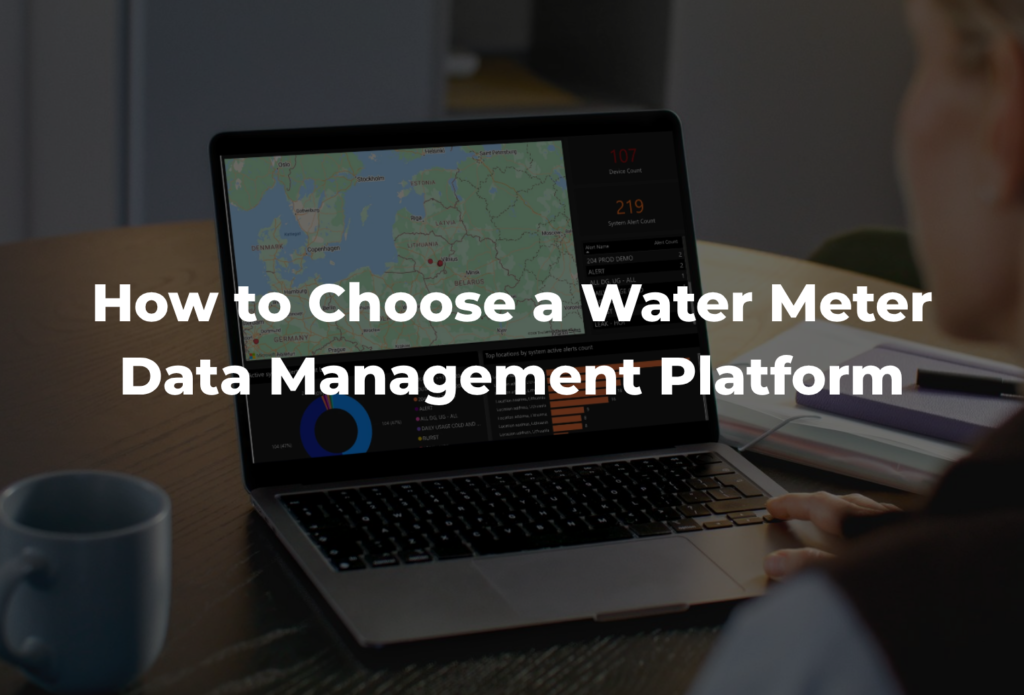
How to Choose a Water Meter Data Management Platform
2026-09-18A remote water consumption monitoring system automatically reads water consumption, sends it to a central platform and raises an alert when a flow pattern appears abnormal. Choosing one is hard, because most vendors describe the same three things: a meter, a communication, and a dashboard.
The differences that determine the result lie beneath the surface: how often data arrives, what triggers an alert, how much hardware goes into each unit, and whether readings leave the platform in a format a billing system can read. This guide sets out an evaluation order for smart metering buyers, and the questions worth asking before a purchase order is signed.
Key Takeaways
- Even though the meter is still the main deciding factor, the other parts such as reporting interval, alert logic, hardware count per unit, and data export decide whether the system pays back.
- Inquire about data intervals. A system that reports once a day cannot flag a burst pipe on the day it starts.
- Resident app visibility can remove the cost of a display in every unit where the local weights and measures authority accepts it or simply removes part of customer support answers.
- Utilities and property managers need identical readings but different outputs. Utilities need district balancing. Property owners need billing ready exports.
- Vendor cost models and named deployments are two different classes of evidence. Ask which one every number in a proposal belongs to.
Which Areas Matter Most in an Evaluation?
| Area to evaluate | What to ask | Why it matters |
|---|---|---|
| Meter performance | What accuracy and low flow performance does the meter provide? | Determines how reliably both normal consumption and smaller flows are measured |
| Data frequency | How often are readings recorded and transmitted? | Affects how quickly changes in consumption become visible |
| Alert logic | Where are leak, burst, or temperature alerts generated? | Determines how quickly abnormal conditions can trigger action |
| Hardware requirements | What equipment is required at each meter and across the property? | Affects installation complexity and future maintenance |
| Connectivity | Which communication technologies are available? | Determines coverage, network ownership, and recurring communication requirements |
| Software platform | Can data be analyzed, exported, and integrated with existing systems? | Determines whether meter data can support everyday operations |
| Data ownership | Can historical readings be exported if the supplier changes? | Reduces future dependence on a single system |
What Is a Remote Water Consumption Monitoring System?
A remote water consumption monitoring system is a connected metering setup that measures water use at each meter point, transmits readings wirelessly to a central platform, and converts them into consumption reports, billing data, and automated alerts, without requiring a site visit for each reading.
Two related technologies are worth ruling out early. A system that collects monthly readings from a vehicle driving past the property is automated meter reading (AMR), rather than monitoring. It removes manual labor but does not provide continuous remote access or analytics. A point leak sensor performs a different task. It reports water at a specific physical location rather than measuring consumption through the pipe, so it will not identify abnormal consumption that never reaches it.
Which Components Actually Decide the Outcome?
Five components make up most systems, and only one is difficult to change later.
- Meter. Measures flow and, on modern devices, generates alerts itself. Replacing it means re-entering every unit.
- Communication. Built into the meter body or installed as a separate transceiver. This sets the per-unit hardware count.
- Gateway. Collects readings from meters in range and forwards them. How many a site needs is determined by a propagation study, not by a fixed number per building.
- Platform. Stores readings, applies analytics, and exports to billing. Here the system either joins the existing stack or becomes a second one.
- App. Gives residents their own view of consumption, which in some states carries regulatory weight.
How Often Does the Data Need to Arrive?
There is no single reporting interval correct for every project, but the interval is the specification most likely to determine what a system can and cannot catch.
Daily readings support accurate billing and trend reporting. They cannot show that a supply line failed at 2 a.m., because the next transmission could be nearly a day away. The US Environmental Protection Agency notes that advanced metering infrastructure, or AMI, meters often collect consumption hourly or more frequently, and that this data can help facilities identify trends and uncover leaks. Hourly reporting is a practical floor for leak response in occupied buildings. Utilities running district metered areas usually want even tighter intervals, since balancing a zone against its inlet meter requires readings that line up in time.
Scheduled readings are not the whole picture. Some meters can detect abnormal conditions locally and independently of the normal reading schedule, which affects detection speed far more than the base reporting interval does.
What Separates a Leak Alert From a Consumption Report?
A consumption report shows how much water has already been used. An alert is meant to flag a pattern that needs attention.
Thresholds vary by meter and configuration, but the alerts buyers ask about most often are:
- Continuous flow. Flow that never drops to zero across a defined window, measured as a share of the meter’s rated flow. This is what typically catches a running toilet or an open tap.
- Burst. A much larger share of rated flow sustained over a shorter period, pointing to a failed line rather than a leaking fixture.
- Freeze. Water temperature falling toward a range indicating freezing risk, useful for unheated risers and outdoor installations.
Ask what triggers each alert, where it is generated, how fast it travels, and who receives it.
The EPA’s WaterSense program reports that 10% of homes have leaks that waste 90 gallons or more per day. Across a property with 200 units, that is a recurring loss that a monthly read will not surface.
Mainlink’s smart metering solution was implemented by our local partner, Meternet, at the 1,700-unit Irvine Campus Housing Authority community in California, achieving substantial savings for the property. Ultrasonic meters revealed previously undetected leaks that older analog meters had not registered, allowing both residents and management to identify and fix issues such as slow leaks and intermittent irrigation system failures. With access to daily and hourly consumption data, abnormal usage patterns were quickly identified and addressed. As leaks were repaired, the community’s overall water consumption declined significantly from an average of about 310,000 gallons per day in September to roughly 255,000 gallons per day by February.
For utilities, the same consumption data can also inform non-revenue water analysis by comparing metered consumption with water entering a defined portion of the network.
Which Connectivity Option Fits the Site?
| Connectivity option | Where it may fit | What to check first |
|---|---|---|
| LoRaWAN | Multifamily buildings, single family districts, manufactured housing communities, rural and dense areas | Building penetration, gateway placement, coverage, redundancy, and network ownership |
| NB-IoT | Distributed meters where suitable cellular coverage is confirmed | Carrier coverage, subscription cost, signal quality, and long-term network availability |
Construction, underground meter rooms, metal infrastructure, antenna placement and redundancy all change network design, so a coverage assessment beats an assumed gateway ratio.
What Should You Ask Any Vendor?
- Can critical events be transmitted between scheduled readings?
- What happens if communication is temporarily unavailable?
- Which alerts are generated on the meter, and which are generated on the platform afterward?
- What battery and maintenance assumptions apply at the interval we actually plan to use, and what is each item’s replacement cycle?
- Can the platform send data that our billing system can read via an application programming interface (API) or another standard export?
- Which performance and savings figures come from completed deployments, and which come from a cost model?
Common Mistakes When Comparing Systems
Buying on meter alone. Meter functionalities and capabilities are very important, but overall solution, architecture of the system, reporting, data analysis, meter reading frequency – needs additional indepth analysis.
Ignoring how much hardware sits in each unit. Separate transceivers, repeaters, wall displays, and other equipment each add a battery, wires, a failure point, and an install line item. The total architecture matters more than the meter price alone.
Assuming one connectivity technology works everywhere. A communication method that performs well in one property may behave differently in underground rooms, dense concrete buildings, or dispersed outdoor installations.
When Remote Monitoring May Not Be the Right Choice
A complete remote monitoring system is not necessary in every situation. If the objective is only detecting water reaching a particular room or appliance, a point leak sensor may cost less and do the job.
If automatic shutoff is required rather than alerting, specify and price it separately. Monitoring and remote valve control are different capabilities.
Organizations already standardized on a mature metering ecosystem should also weigh whether replacing it would create enough operational value to justify the migration.
How Mainlink Approaches Remote Water Monitoring
Mainlink builds an integrated smart metering solution across layers: ultrasonic meters, connected sensors for conditions the meter cannot see on its own, the Mainlink AMI platform that turns readings into alerts, reports, billing exports and LoRaWAN communication network. Each layer comes from one supplier rather than from separate vendors.
| Attribute | Details |
|---|---|
| System category | Meters, sensors, gateways, network and platform from one supplier |
| Field hardware | No transceivers or repeaters are required between the meter and the gateway, and no display is required inside each unit (applicable for CA state). The gateway count is set by a site coverage survey |
| Connectivity | LoRaWAN |
| Data platform | Combines meter data management and head end system functions, and accepts data from different meters |
| Resident visibility | Mobile app showing each unit’s consumption and alerts |
| Alerting scope | Leak, burst and freeze alerts. |
Property managers focus on consumption per unit, leak alerts, and billing data. Utilities use the same architecture for automated meter reading, network monitoring, and district analysis.
What decides the outcome is whether accurate consumption data reaches the right people and systems fast enough to support billing, maintenance and customer service.
Frequently Asked Questions
What is the difference between automated meter reading and a remote water monitoring system?
Automated meter reading primarily replaces manual collection, often by periodically taking readings from a passing vehicle or walking by. A remote monitoring system transmits data continuously to a platform that also generates alerts and billing exports, thereby changing what a buyer can act on.
How quickly can a remote system identify a leak?
It depends on the alert threshold, where the alert is generated, communication frequency, and notification settings, not on the reading interval alone. A meter that raises a constant flow alert on the device and reports hourly will surface a running fixture within a day. A system reporting only daily cannot.
Can the same platform support utilities and apartment properties?
Yes, Mainlink’s remote metering solution is suitable for utilities and apartmetn property managers. Platform supports billing exports for each unit alongside district analysis from the same readings, since the two audiences need different outputs from identical data.
Does remote monitoring automatically include remote valve shutoff?
It could be. Remote valve shut-off solution is separate solution that Mainlink offers. It combines ultrasonic meter with remote shut-off valve and platform for meter data management.
How many gateways does a property need?
There is no fixed number. It depends on site size and construction, meter locations, interference, and antenna placement. Published deployments range from one gateway to several in a single building. A coverage survey before ordering settles it.
Next Step
Before comparing meter specifications, define what the system must accomplish: meter functionalities, reading frequency, alert workflow, billing integration, connectivity conditions, software features, data ownership.
Bring a unit count, your current reading method, and the jurisdiction you operate in, and solution providers, such as Mainlink, can provide you a metering solution according to your needs.