


Mainlink at Apartmentalize: Showcasing Utility Cost Recovery Solutions
2026-06-20
What Is Smart Metering? How It Works, Types & Benefits
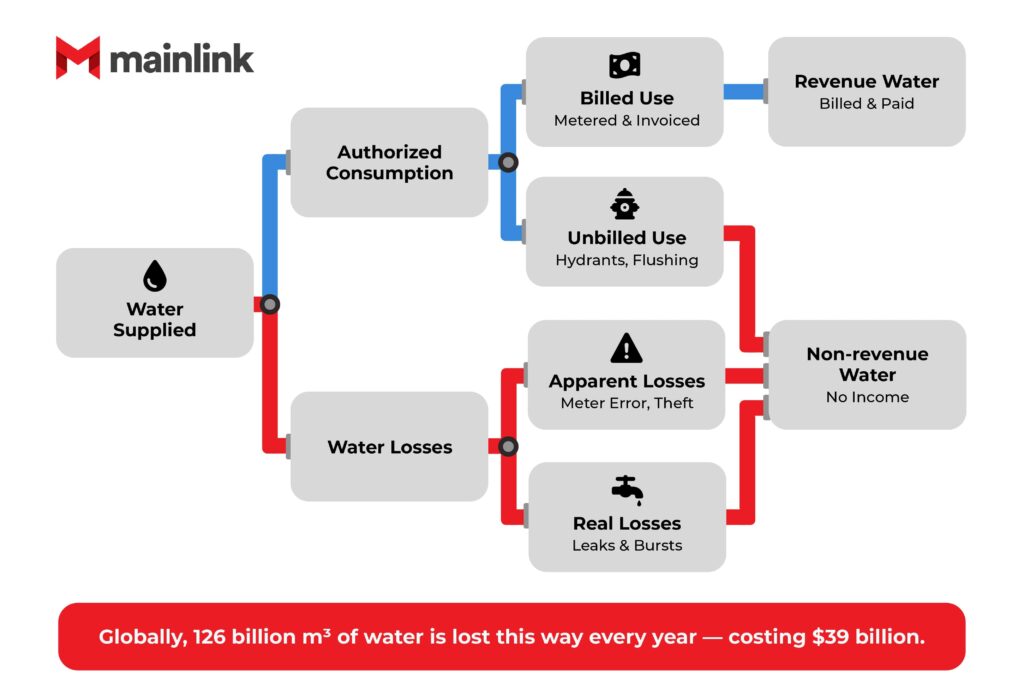
2026-08-01Non-revenue water (NRW) is water produced and entering the distribution system that does not generate revenue because it has been lost, consumed without billing, or inaccurately measured. It’s the difference between system input volume and billed, authorized consumption. Non-revenue water is a global issue. According to the International Water Association (IWA), approximately 126 billion m³ of water is lost every year, with an estimated economic cost of around US$39 billion.
By understanding the causes of NRW and implementing targeted reduction strategies, utilities can improve network efficiency, while property owners can reduce water losses, improve billing accuracy, and lower operating costs. This article will cover what non-revenue water is, the causes of NRW, how to calculate NRW, reduction and control strategies, and the benefits of reducing it.
What is Non-Revenue Water?
Under the International Water Association (IWA) Water Balance Framework, NRW is defined as the difference between the System Input Volume and Billed Authorized Consumption.
What this means in practice is that the utility has produced, treated, and supplied water, but has not received the revenue associated with it. It’s the difference between the volume of water entering a distribution system and the volume of water billed to customers.
According to the IWA, there are three components to NRW:
- Real (physical) water losses: Actual physical losses of water from the network, such as leaks in distribution mains, pipe bursts, leakage from service connections, or reservoir and tank overflows or leaks. This water is lost before reaching the customer meter.
- Apparent (commercial) losses: Rather than physical water losses, these are caused by meter inaccuracies, unauthorized consumption (e.g. theft), illegal connections, and data handling or billing errors. In this case, water is consumed, but the utility does not accurately measure or bill for it.
- Unbilled authorized consumption: Some water usage is authorized but not billed, such as firefighting, water main flushing, tank cleaning, utility operational use, or municipal services. Although it serves a valid and authorized purpose, it is NRW because it does not generate revenue.
How Do Utilities Calculate Non-Revenue Water?
Utilities track NRW to measure water loss performance, benchmark utility efficiency, identify NRW reduction opportunities, and track the effectiveness of water loss management programs. The IWA Water Balance is the internationally recognized framework used by utilities to classify water consumption and losses.
NRW is calculated according to a formula:
NRW = System Input Volume – Billed Authorized Consumption
The “system input volume” is the total amount of water that has entered the system, regardless of how it has been used or where it will go. “Billed authorized consumption” includes every legitimate purpose for which the water has been used, and for which revenue has been received. Subtracting billed authorized consumption from the system input volume gives the volume of non-revenue water—water that does not generate revenue because it has been lost, consumed without billing, or inaccurately measured.
Let’s consider a practical example using hypothetical numbers. Imagine a system with a total input volume of 10 million gallons a day, and a total billed authorized consumption of 7 million gallons a day. The calculation looks like this:
10,000,000 – 7,000,000 = 3,000,000
This means the utility has 3 million gallons per day of non-revenue water.
Typically, NRW is expressed as a percentage of total system input:
NRW % = (NRW Volume / System Input Volume) x 100
This calculation allows utilities to express NRW as a percentage of the total system input, enabling an easy understanding of how much water has been lost relative to the total input. Following on from our earlier example, we can calculate:
(3,000,000 / 10,000,000) x 100 = 30%
This means that in our hypothetical example using purely theoretical numbers, the utility loses 30% of its total water production as non-revenue water.
What are the Main Causes of Non-Revenue Water?
The causes of NRW are multifaceted and encompass physical (real) losses, apparent (commercial) losses, and unbilled authorized consumption. There’s no single cause, and all three loss types have multiple contributing factors, all of which pose a significant challenge to utilities.
Here, we’ll discuss the main causes of NRW in more detail.
Real (Physical) Losses
In many utilities, physical losses represent the largest component of NRW. These losses primarily come from leaks and bursts. This can be due to aging infrastructure, where deteriorated pipes or material failure cause leaks; pipe bursts due to pressure fluctuations or structural failures; hidden underground leaks and other difficult-to-detect distribution losses in large pipe networks; and leaks and operational failures in reservoirs and tanks.
Physical losses are difficult to manage because they can occur at various points throughout the distribution network, which may be large and poorly visible. Many leaks go completely unnoticed under the surface, leading to significant annual water losses. Aging infrastructure in many systems exacerbates this issue, as older pipes are more prone to leaks, bursts, and other issues. In this context, non-revenue water leakage management is an essential strategic tool to mitigate NRW.
Apparent (Commercial) Losses
Apparent (commercial) water losses are generally due to unauthorized consumption and metering inaccuracies. Typically, these errors fall into four categories: meter inaccuracy due to aging mechanical meters or under-registration; unauthorized consumption, from illegal connections or meter tampering; billing errors through data entry mistakes or customer account issues; and poor data management, such as incomplete customer records or inefficient meter reading practices.
Commercial water losses are typically smaller in volume than physical losses, but reducing non-revenue water in this context is still beneficial, leading to increased billed volume and revenues. Smart ultrasonic meters are resistant to magnetic tampering and can significantly reduce this type of meter fraud.
Unbilled Authorized Consumption
Unbilled authorized consumption is different from the other two types of NRW in that it’s the result of legitimate consumption. It’s still NRW water because ultimately, the water has been used but not billed. Unbilled authorized consumption typically occurs from water used for firefighting, water main flushing, utility operations, municipal services, and parks and public facilities.
This can be a difficult source of NRW to manage, as it is not a result of physical infrastructure damage or inefficiencies, and has not been stolen or otherwise misallocated.
The Scale of Non-Revenue Water Loss
Non-revenue water loss is a global problem. 126 billion m3 of water is lost worldwide annually, with an approximate annual value of $39b. Despite this, NRW levels vary significantly across countries and utilities — from 5% to 80% depending on the region, according to research published by the IWA — while research published in the Journal of King Saud University suggests that developing countries typically experience substantially higher NRW than developed countries with more mature, resilient systems.
NRW performance also varies across utilities; many industry sources consider that world-class facilities can achieve under 10%, while less well-managed utilities can expect NRW of up to 40% or more.
This large spread suggests that, in some cases, adoption of non-revenue water management tools and strategies is insufficient, or that implementation has been poor. Although this means losses in many cases remain significant, it also means that there is still substantial scope for additional non-revenue water reduction and control that has not yet been effectively implemented.
How Utilities Reduce Non-Revenue Water?
Non-revenue water reduction involves effective water loss management, infrastructure maintenance and management, operational monitoring, smart technology deployment, and revenue protection. No single tool is sufficient, but through implementing holistic strategies across a wide number of management practices, utilities can reduce NRW.
District Metered Areas (DMAs)
Rather than tracking an entire utility region, utilities often subdivide their operational area into smaller zones known as District Metered Areas (DMAs). This enables utilities to identify high-loss areas much more easily than by monitoring the entire distribution network at once, and to implement more targeted, prioritized interventions. This works because losses often occur in specific regions and can be masked by aggregated system data. A single large, unknown system can be transformed into multiple small, measurable systems.
Using Minimum Night Flow, utilities can detect hidden leaks, background leakage, pipe joint failures, service connection leakage, and pressure-driven losses in these DMAs. This is because nighttime consumption is predictable and low; when utilities compare the expected night demand with the measured flow, the difference is understood as potential real losses.
Techniques like MNF would be extremely difficult to implement outside DMAs, but they provide a robust diagnostic framework for subsequent interventions.
Active Leak Detection
Active leak detection refers to a suite of methods and tools used to proactively find leaks and sources of physical water losses. This type of non-revenue water leakage management relies on diverse technologies and techniques to find leaks before they surface.
Acoustic sensors and leak correlators typically rely on placing these devices on pipes, valves, or hydrants to listen for sounds indicating leaks. Satellite leak detection uses remote sensing technologies to identify moisture anomalies associated with underground leaks, whereas ground-penetrating radar sends electromagnetic waves into the ground to detect subsurface structures and anomalies. These active leak detection systems are intended to catch leaks before they become catastrophic failures.
By using ultrasonic water meters, leak sensors, satellite leak detection, and ground-penetrating radar, advanced monitoring platforms, utilities can reduce their water losses and lower their repair costs, as they’ve found difficult to detect hidden leaks early enough to prevent substantial infrastructure damage.
Pressure Management
Pressure management is based on the hydraulic principle that the leakage rate increases with pressure. This means that higher pressures result in greater pipe stress and, therefore, greater leakage.
Utilities implement various methods to manage this, including pressure-reducing valves, which lower and stabilize downstream pressure in the pipe system; pressure zoning (sectorization), which is dividing a network into separate zones with controlled pressure levels to prevent overpressurization of areas and standardize conditions across the network; and smart pressure management systems, designed to continuously monitor pressure and adjust PRVs dynamically.
Together, these systems allow the network to adapt to local demand fluctuations and prevent pressure spikes.
Smart Metering and Data Analytics
Modern ultrasonic water meters offer a practical water tracking solution for leaks, especially when paired with advanced smart metering platform. Smart metering and data analytics can help utilities address both real and apparent losses, positioning them as effective tools for non-revenue water management.
Network visibility is a core problem for utilities, as is accurate water tracking. Many utilities are burdened with aging mechanical infrastructure that can under-register at low flows, degrade further over time, and miss intermittent usage patterns. Smart meters can measure at low flow rates, maintain their accuracy over time, and reduce systematic under-billing. Additionally, continuous real-time monitoring enables leak alerts, burst detection, and the identification of abnormal consumption patterns, resulting in faster response times.
Ultrasonic meters are also effective at detecting tampering, as many can detect reverse flow, magnetic interference, and physical tampering. Automated readings also eliminate manual reading errors, estimation-based billing, and data entry mistakes.
Infrastructure Renewal and Asset Management
Aging infrastructure is the major cause of physical losses in a given water distribution network. Infrastructure renewal and asset management target the root structural causes of NRW, making them important areas for non-revenue water management. This type of non-revenue water reduction is among the most important interventions utilities can undertake.
Typically, this kind of intervention involves assessing the condition of pipes and other infrastructure, replacing aging or damaged pipes, performing preventive maintenance, conducting condition assessments, and implementing risk-based asset management.
On the ground, this usually means assessing pipes and other network infrastructure using age data, material type, historical break and leak frequency, and pressure exposure, then replacing sections as-needed. Utilities typically replace pipes based on the probability of failure, the consequences of failure, and the leakage contribution rather than replacing everything at a set time.
Predictive maintenance can include scheduled inspections, valve maintenance, joint resealing, and targeted repairs to prevent failures. As physical losses are the primary driver of NRW, these interventions offer significant potential for reducing NRW.
Metering and Billing Improvements
Metering and billing inaccuracies and errors is a source of commercial water losses, so improvements in this area directly reduce non-revenue water. These typically involve meter replacement programs, as old mechanical meters generally under-record low flows, lose accuracy over time, and fail to detect small continuous usage. Upgrading to modern infrastructure improves revenue capture accuracy and consumption visibility.
Increasingly, utilities are adopting automated meter reading and advanced meter infrastructure (AMR/AMI). These smart systems replace manual meter readings and data collection with remote and even automated data collection and transmission. This eliminates human reading errors, reduces estimation billing, and improves billing frequency accuracy. Smart infrastructure, including automated billing systems, data validation checks, and easy integration with customer databases, ensures that tracked water is billed correctly. By improving their tracking capabilities and enhancing billing workflows, utilities can reduce under-registration, experience fewer billing disputes, and enjoy more stable cash flow.
Before and After Reduction: What NRW Reduction Can Achieve
Each of the methods considered can have a positive impact on NRW, but what does that look like in practice? Let’s take a hypothetical utility and work through what a successful implementation of NRW reduction strategies can mean.
Before implementing any strategies, the utility has a total system input volume of 100,000,000 m3 each year. It loses 40,000,000 m3. This gives it a significant NRW level of 40%, representing a substantial loss in revenue: almost half of its produced water does not generate any revenue. Research by Liemberger & Wyatt, published by the IWA, estimates the value of NRW as $0.31 per m3. In this hypothetical example, that results in a substantial $12.4m of lost revenue each year.
The utility implements the strategies considered in this article, and reduces its NRW level to 25%. This improvement means that annual water loss is now just 25,000,000 m3, with 15,000,000 m3 per year recovered — representing $4.65m in recovered revenue.
These figures are purely hypothetical and actual financial benefits will depend on specific implementations, operating costs, local tariffs, leakage levels, and the proportion of losses that are recoverable. However,this example illustrates how an effective implementation of NRW reduction strategies can positively impact utility finances.
Benefits of Reducing Non-Revenue Water
Reducing non-revenue water improves both utility finances and service performance, with significant downstream benefits. In this context, it isn’t simply a financial or operational need; the benefits of reducing non-revenue water extend beyond revenue recovery to improve outcomes for all stakeholders.
Reductions in NRW result in:
- Improved Revenue Recovery: NRW directly represents water that generates no revenue; by reducing it, revenue is increased
- Reduced Operational Costs: When utilities treat and pump water that does not generate revenue, this effectively increases their operational costs. When this water is billed, operational costs are effectively reduced due to cost recovery
- Extended Infrastructure Lifespan: Proactive maintenance and management of network assets reduces infrastructure stress, which can improve lifespan and reduce the frequency of replacements
- Better Customer Service and Supply Reliability: Excessive physical NRW can lead to service and supply instability, significantly impacting customer satisfaction and service continuity. When utilities minimize these issues, customers enjoy better services and are less likely to raise complaints
- Environmental Stability: Environmental sustainability is increasingly a core concern across the water industry, and reductions in NRW directly result in less wasted water. Additionally, NRW results in wasted treatment and pumping energy, so reducing it helps conserve energy as well as water
- Regulatory and Performance Compliance: NRW is often used as a performance metric, and many regulatory environments mandate significant water conservation. Reductions in NRW help utilities meet these goals
How Does Non-Revenue Water Affect Consumers?
Non-revenue water affects consumers by increasing their bills and impacting their service reliability. It directly and indirectly impacts consumers; it isn’t simply a problem for utilities. By taking active steps to reduce non-revenue water, utilities can improve customer experience and manage resources more effectively, enabling greater investment into upgrades, maintenance, and network expansions.
The four core areas where NRW affects customers are intermittent supply, higher water bills, risks to water quality, and infrastructure reliability.
Intermittent Supply
High levels of NRW affect utilities’ ability to deliver services, leading to inconsistent supply that fails to meet customer demand.
Higher Bills
When utilities lose revenue due to NRW, they often seek to recover costs through tariffs and rate adjustments. This directly impacts consumers by increasing their bills.
Infrastructure Reliability
When utilities suffer from excessive NRW, this can impact their ability to invest in infrastructure and maintenance. More leaks, breaks, and other incidents can lead to more frequent service interruptions, directly affecting service performance and customer satisfaction.
Water Quality
Pipe breaks contribute to NRW, but they can also create temporary water quality risks. According to US EPA research, leaks and pipe breaks can increase the risk of contamination entering the system when the pressure drops. When the system has the correct pressure, these contaminants are unable to enter the system; if pressure drops due to leakages or other issues, this is no longer the case. This source of contamination, in addition to backflow events, has been known to cause illnesses in consumers, but can be mitigated by preventative and corrective measures.
Conclusion
In a world characterized by increasing demand for water and declining water resources, the widespread problem of non-revenue water (NRW) poses a significant challenge for global water management.
NRW is an urgent problem: its profound implications for water availability, utility finances, and environmental sustainability make NRW reductions a necessity, not merely desirable. Through modern technologies such as ultrasonic water meters and data management platforms, infrastructure upgrades, and effective policy, utilities can substantially reduce NRW.
Interested in learning more about how smart water meters can help? Our article on smart water meters explains how they work and the benefits they offer. Alternatively, you can contact us for a consultation on how we can assist you in reducing non-revenue water.