


How to Choose a Water Submetering Company
2026-08-24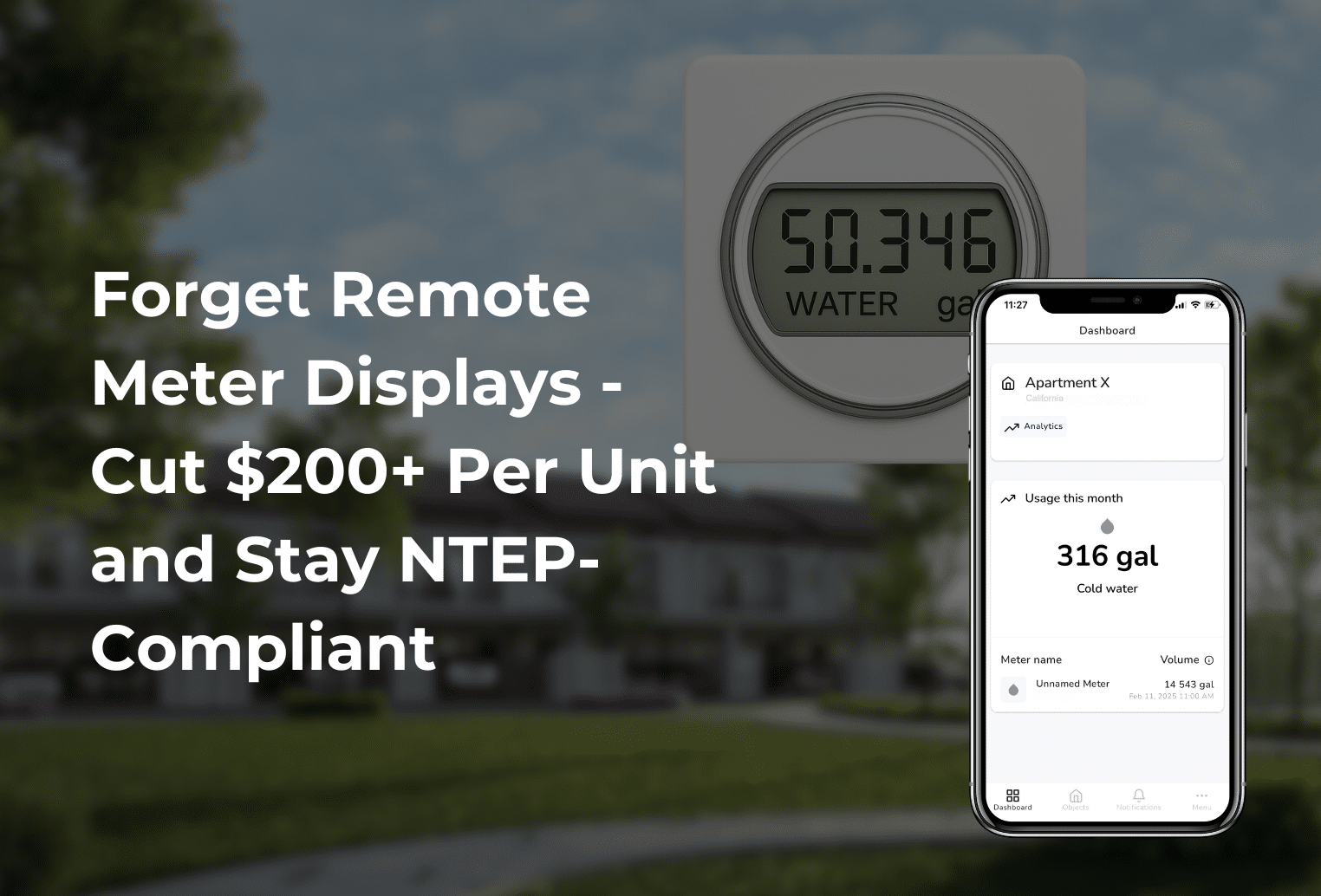
Forget Remote Meter Displays — Cut $200 Per Unit and Stay NTEP-Compliant
2026-08-24Many types of water meters are available; the most common are positive displacement, velocity, ultrasonic, electromagnetic, and compound meters. Although all water meters are designed to measure water consumption, they do so in different ways that affect accuracy and operating parameters. Because of these practical differences, technology type is one of the most common ways to categorize water meters.
Different types of water meters are most useful in different scenarios, so technology type is a form of categorization that works well; however, it is not the only useful classification system. Water meters are also classified by other metrics, such as their intended application, reading method, or installation method, as many buyers wish to evaluate meters across several relevant metrics.
In this article, we’ll consider the main classification methods for types of water meters, how to choose the right water meter type, and answer common questions.
Types of Water Meters by Measurement Technology
Measurement technology is the primary classification for water meters used across the industry. This is because measurement technology is a fundamental difference between types that has multiple practical deployment considerations, from accuracy to suitability in different contexts and even maintenance requirements.
There are two broad families of water meters: mechanical water meters, in which moving components measure flow, and electronic or non-mechanical water meters, in which electronic sensors without moving parts measure flow. Within each broad category, different technologies are utilized, each one optimized for different flow ranges, accuracy requirements, pipe sizes, and water conditions.
Positive Displacement Meters
Positive displacement meters are the most common residential water metering technology in use today. Positive displacement meters are mechanical meters that measure known volumes of water. This is a type of volumetric flow measurement, as it measures actual volumes of water, making positive displacement meters an example of a volumetric meter.
They do this by trapping water in a measuring chamber of known volume, then emptying it repeatedly. These repeated chamber cycles are counted and converted into a total water volume. Positive displacement is effective and extremely accurate at low flow, making it a popular choice for water metering — it’s the most common domestic water meter type in North America. Low-flow accuracy matters because it enables meters to track leaks, dripping taps, and overnight consumption, leading to more accurate billing.
PD meters are widely used across single-family residential homes, apartments, and small commercial buildings. Typical PD meters are available in common pipe sizes of ⅝”, ¾”, 1”, and up to around 2”.
There are two main designs of positive displacement meters: nutating disk and oscillating piston. They operate on the same principle of measuring fixed volumes of water but use different internal mechanisms. Next, we’ll consider these two subtypes.
Nutating Disk
In nutating disk meters, an angled disk rocks (or “nutates”) back and forth as water flows through the meter. Each of these “nutations” represents a known volume of water, and the meter counts these movements to calculate total water usage. They’re common in residential water meters because it’s a simple, durable, and accurate method at low flow rates.
Oscillating Piston
In oscillating piston meters, water moves a piston back and forth inside a measuring chamber. Each piston movement displaces a fixed volume of water, which is then counted to measure overall consumption. As with nutating disks, oscillating piston meters are accurate at low flow rates, and they’re commonly found in residential and small commercial applications.
Velocity Meters (Turbine, Single-Jet, Multi-Jet)
Velocity-based flow measurement is fundamentally different from volumetric measurement. It isn’t better or worse; it’s based on completely different mechanisms from volumetric water meters, such as positive displacement meters.
Velocity meters include turbine-based meters, single-jet, and multi-jet meters. They’re a type of mechanical water meter. In velocity-based measurement, water velocity rotates an impeller or turbine, and the resulting torque is converted into volume. They perform better at medium and high flows, and are generally less accurate than PD meters at low flows. These characteristics make them better suited to larger services than to single-family residential.
Common applications for velocity meters include commercial applications, irrigation, larger residential services, and municipal distribution.
Popular types of velocity meters include turbine, single-jet, multi-jet, and Woltman meters, which we will discuss next.
Turbine Meters
Turbine meters are a common type of velocity meter that measure water flow by using the rotation of a turbine inside the pipe. When the water moves faster, so does the turbine, and the meter converts this speed into a flow measurement. These are better suited for applications with higher flow rates.
Single-Jet Meters
Jet-based velocity meters use a jet stream to drive an impeller (a small rotor) and make it spin. In single-jet meters, there’s a single stream of water. When the jet stream spins the rotor, the rotation can be used to calculate water usage. It has a simple design, usually fits smaller pipes, and is typical for lower-cost applications.
Multi-Jet Meters
Multi-jet meters are conceptually similar to single-jet meters, but utilize multiple jets that hit the impeller from different directions. This creates a more balanced flow around the rotor, which improves accuracy and can reduce wear.
Woltman Meters
Woltman meters are large turbine-style meters designed for big pipes and large water volumes. The turbine sits in line with the water flow and is commonly used in commercial buildings, industrial sites, irrigation, and utility networks.
Ultrasonic Water Meters
Ultrasonic water meters utilize innovative modern technology to measure water consumption. These are electronic meters that measure water by using sound waves to determine flow velocity. They’re the leading modern technology in water metering and are increasingly popular as property owners upgrade existing legacy systems.
Unlike a mechanical meter, an ultrasonic water meter has no moving measuring parts (e.g., turbines or propellers). It uses sound waves to determine flow velocity through one of two methods (transit-time and Doppler). Integrated electronics calculate volume.
Ultrasonic meters offer numerous advantages, such as excellent low-flow sensitivity, long service life, reduced wear, low maintenance, smart metering compatibility, AMI integration, and IoT compatibility. They’re increasingly common across multiple water metering applications, from residential contexts to commercial, industrial, and submetering across multiple industries.
There are two types of ultrasonic water meters, classified according to the precise mechanism of ultrasonic measurement. These are transit-time and Doppler, which we will now consider.
Transit-time
Transit-time ultrasonic water meters measure the difference in travel time upstream and downstream for ultrasonic sound waves. In transit-time, an ultrasonic wave is sent upstream and downstream through a pipe. The time it takes for these waves to travel is used to calculate the flow. This method is preferred for clean water, as particles in the liquid can disrupt the measurements. It’s the dominant ultrasonic technology used in potable water, such as residential metering contexts, as this water is clean and particulate-free.
Doppler
The Doppler method used by ultrasonic water meters is different in that although it utilizes ultrasonic sound waves, it relies on reflected sound instead of measuring transit time. In Doppler, particulates or bubbles in the fluid reflect the sound waves, and the change in frequency can be used to calculate velocity and, therefore, flow. As Doppler relies on suspended particles or bubbles in the fluid, it’s more common in wastewater and challenging fluids than in potable water contexts.
Electromagnetic Water Meters (Mag Meters)
Electromagnetic meters are a non-mechanical technology designed for larger pipes, conductive liquids, and demanding commercial or industrial applications. They operate according to Faraday’s Law of Electromagnetic Induction. A magnetic field is generated inside the meter, and water — which is a conductive liquid — moving through the field naturally induces a voltage. The induced voltage is proportional to the flow velocity, which the integrated electronics can convert into a volumetric flow rate.
Like ultrasonic meters, electromagnetic meters have no moving parts and have low mechanical wear. They provide excellent accuracy over a wide flow range. There’s minimal pressure loss, and it’s suitable for dirty or sediment-filled water. However, this mechanism of action requires electrically conductive liquids, so isn’t suitable for distilled or non-conductive fluids, and it requires electrical power.
Mag meters are typically used in municipal water systems, wastewater, industrial facilities, process water, large commercial buildings, and large-diameter pipelines.
Compound Meters
Compound meters aren’t a third kind of measuring principle. Instead, they combine existing technologies to achieve a broader operating range. This enables the same meter to operate in both low and high flow rates in some implementations, which can be essential for operational needs.
Compound meters combine two meter technologies, usually positive displacement and turbine meters, with automatic changeover valves to direct the flow. Low flows are measured by the smaller meter, while the turbine measures high flows.
This approach works because they can operate within very wide flow ranges where a single meter type would be insufficient, maintaining billing accuracy and reducing under-registration. They’re commonly used in hospitals, schools, hotels, office buildings, fire service connections, and large commercial facilities — applications where water consumption changes rapidly from high to low.
Water Meter Types Comparison
Every water meter technology has advantages and disadvantages, so there’s no single technology that’s best for every application. There are trade-offs to consider during real-world implementation. Selection therefore depends on multiple factors.
The following table compares water meter types by metrics such as low-flow accuracy, typical pipe sizes, maintenance requirements, relative costs, and expected lifespan.
| Feature | Positive Displacement | Velocity | Ultrasonic | Electomagnetic | Compound |
| Working principle | Known-volume chamber | Water velocity | Ultrasonic signals | Magnetic induction | PD + turbine |
| Moving parts | Yes | Yes | No | No | Yes |
| Low-flow accuracy | Excellent | Medium | Excellent | Excellent | Excellent |
| High-flow capability | Medium | Excellent | Excellent | Excellent | Excellent |
| Typical pipe sizes | ⅝” – 2” | ¾” – 12”+ | ⅝” to large mains | Large pipelines | 2” – 10”+ |
| Best for | Residential | Commercial | Residential – Industrial | Industrial | Highly-variable commercial or institutional |
| Maintenance | Medium | Medium | Low | Low | Medium |
| Expected lifespan | High | High | Very high | Very high | High |
| Relative cost | Low | Medium | High | High | High |
Water Meter Types by Application
Water meters are also commonly classified by their application. Water meter selection depends on pipe size, expected flow range, water quality, billing requirements, and the installation environment, so it’s sensible to group meters by use case, since these metrics are similar across implementations within a given application. Different buildings and contexts use different meter types because they are more suited to particular applications.
There are three common applications for water meters: residential, commercial, and industrial. Additionally, water submetering is a sufficiently different application that it is often treated separately.
Residential Water Meters
Residential water metering typically requires excellent low-flow accuracy, economical designs, and proven technology that can simplify installation and operation. Typical service sizes are ⅝”, ¾”, and 1”, so we typically don’t see electromagnetic or compound meters in residential contexts.
These requirements mean that positive displacement meters remain dominant across North America, as they are relatively low-cost, effective, and enjoy legacy status as an industry standard.
However, in recent years, new construction and retrofit upgrades mean that increasingly, property owners are opting for ultrasonic smart meters for easier integration into smart systems. These meters offer excellent accuracy at low flow rates and, despite a higher upfront cost, typically have a lower total cost of ownership over the long term. Ultrasonic water meters integrate relatively easily into IoT systems, making them a sensible choice for many AMI deployments where automatic data collection, remote reading, and automated data transmission are priorities. In addition to advanced features such as leak detection, these qualities make ultrasonic meters an increasingly attractive option for modern deployments, despite the low cost and legacy status of positive displacement meters.
Commercial Water Meters
Commercial facilities typically require wider measuring ranges due to substantial fluctuations in daily use throughout peak and off-peak periods. Larger pipe diameters, varying occupancy, the need for greater billing precision, irrigation, and mixed demand contribute to more intensive requirements than residential water metering.
In commercial water metering, pipe sizes vary from around 1” to more than 24”. This necessitates different metering approaches, but the choice of meter depends on the flow profile and the pipe diameter.
As such, commercial water metering is less focused on simple, low-cost deployments and instead relies on metering infrastructure capable of managing complex and varied operational needs across multifamily properties, retail spaces, and other commercial buildings. This ensures that a wide range of meter types are used, including turbine, electromagnetic, ultrasonic, and compound meters.
Turbine meters are commonly used from around 1½” upwards, especially where there are consistent medium-to-high flow rates. They work well in larger commercial services because they can handle more flow than typical residential positive displacement meters.
Compound meters exist because many commercial buildings experience both tiny background flows (leaks and overnight usage) and very high peak demand. Combining positive displacement meters for low flows and turbine meters for high flows ensures accurate billing across the entire operating range. They’re typically used for pipes ranging from 2” to 10”.
Electromagnetic meters are used on larger services, from 2” to 24”, especially where low maintenance and long-term reliability matter. Ultrasonic meters are also available and suitable for very large pipe sizes, making them suitable for a wide range of commercial applications.
Industrial Water Meters
Industrial water metering typically prioritizes durability, minimal maintenance, and reliable measurement under challenging conditions. Billing is an important factor in commercial and residential contexts, but it’s relatively less important a factor in industrial water metering. In industrial water metering, practical process requirements are an immediate challenge that needs to be adequately addressed before other concerns.
Pipe sizes in industrial water metering range from 2” on the smaller end to 24” or more on the larger end and often involve hazardous materials.
This necessitates a focus on meters that can operate consistently and reliably under often extremely challenging conditions. Due to this, industrial metering typically requires meters designed for very large pipe diameters, continuous operation, dirty or abrasive water, chemicals, wastewater, and rapidly changing water flow.
Electromagnetic meters are widely used because they have no moving components in the flow and handle dirty conductive liquids well. They’re common in manufacturing, wastewater treatment, and process industries. Ultrasonic meters are often used where clean water, large pipes, or non-invasive measurement are important. Clamp-on varieties are especially useful because they can often be installed without shutting down the process. Coriolis meters measure mass flow rather than volume, making them useful in industries where fluid density or precise dosing is critical, such as pharmaceuticals.
Water Submetering
Water submeters are secondary meters that are installed per unit in multi-tenant properties. They track individual unit-level water consumption, whereas the property’s master meter measures all the water entering a property from the utility company. Water submetering is used extensively in multifamily residential, commercial, and industrial settings.
Submetering can apply to individual buildings across a development, individual mobile homes on a mobile home park, individual units within a larger building, and even to zones within an industrial facility or specific machines. Submeters enable precise, granular tracking that can be assigned to a particular tenant or use. For example, an apartment block may have a single utility-supplied master meter, and each apartment will then have its own water submeter tracking that unit’s actual water consumption.
The reason for submetering in residential and commercial contexts is generally fair billing, as it enables each occupant to pay for the water that they have actually consumed via per-unit billing. This is especially useful in multi-tenant settings. In industrial contexts, it’s often used to monitor processes, allocate resources, and track machine or zone performance rather than strictly for billing purposes.
Many legacy submetering systems use mechanical submeters, but increasingly, property owners are adopting ultrasonic meters for their water submetering systems. Ultrasonic meters are an effective choice for submetering, as they are compact, low-maintenance, AMI-ready and IoT-capable, with long service lives.
Water Types by Reading Method
Meters utilize various measuring technologies to generate consumption data, but this is entirely separate from the reading method. The reading method refers to how this generated data is collected for further use. There are three broad types of reading method for water meters: manual readings, Automated Meter Reading (AMR), and Advanced Metering Infrastructure (AMI).
Any kind of measurement technology can be used with any type of meter reading method.
Manual Read
Manual reading is the simplest, most traditional method of meter reading. The physical meter has a visual register that displays a figure. For manual readings, a utility employee will visit the site to inspect the meter and take a reading physically. This is the lowest technology option for meter reading, and it’s still widely used, especially with legacy hardware.
Automated Meter Reading (AMR)
Automated meter reading simplifies and streamlines data collection by enabling it without physical visits to each meter within a given radius. AMR-enabled meters can support drive-by or walk-by readings, in which a utility employee walks or drives within a certain radius of the meter with a receiver to collect meter data automatically. This reduces the physical labor required for meter readings, which can streamline operations, and typically results in fewer reading errors.
Advanced Metering Infrastructure (AMI)
Advanced metering infrastructure is a newer approach, and AMI-enabled meters are commonly referred to as smart water meters. There are multiple differences in AMI vs. AMR, but the biggest involve the level of automation and two-way communication.
In AMI, there is two-way communication between meters and the utility, enabling near-real-time data collection, remote management, alerts and alarms, leak detection, and support for IoT integrations and data management platforms. In AMI, data collection and transmission are fully automated.
Meters automatically collect data and transmit it to data management platforms and the utility, where it can immediately be used for billing purposes. This significantly reduces the need for physical meter visits and access requirements.
Water Meters by Installation Method
Installation method is another way where meters differ, and it’s a useful metric for classification because practical installation requirements can often dictate meter suitability. Installation methods are usually independent of measurement method.
There are three main methods: inline installation, clamp-on installation, and insertion. Each has advantages and disadvantages.
Inline Installation
Inline meters are installed directly into the pipeline. It’s the most common installation method and is used across residential, commercial, and industrial settings. Inline meters are available across measurement technologies and can work well with a wide range of pipe diameters.
Clamp-on Installation
Clamp-on meters are sensors attached to the outside of the pipe. They require no pipe cutting, but some technologies cannot be used this way because their measurement methods are incompatible. Clamp-on meters are generally ultrasonic meters. Clamp-on meters are ideal for temporary surveys, audits, or retrofit projects, since they’re portable and non-invasive.
Insertion Installation
A sensing probe is inserted through a tapping point in the pipe. This is typically used on larger mains, where pipe sizes are large enough that replacing large sections of pipe is not economical. Insertion is often used with electromagnetic and ultrasonic technologies.
How to Choose the Right Water Meter Type
Choosing the right water meter type is about understanding the meter’s capabilities and your specific operational requirements. Evaluation should take place across these seven factors:
- Why do you need to measure?
Different objectives need different technologies. Are you measuring solely for utility billing? Do you want to implement water submetering? Do you need metering for industrial processes? - Pipe size & expected flow range
Meter size matters. Consider the average, peak, and minimum flows when choosing. - Accuracy requirements
Consider how accurate your meter needs to be. Do you need billing-grade measurement, with NTEP certifications? Do you need industrial-grade accuracy for compliance? - Water quality
Poor-quality water often requires different meters than clean water. Ultrasonic, positive displacement, and turbine meters are effective in clean water, but not in dirty water. - Installation requirements
Installation in new construction is often relatively easy, but retrofits can be more challenging. Consider your actual requirements, such as whether water shutoffs are feasible, and whether there’s sufficient maintenance access. - Budget & total cost of ownership
The lowest purchase price isn’t always the lowest lifetime cost. Consider maintenance, expected service life, calibration requirements, replacement intervals, and labor savings in addition to purchase prices. - Smart capabilities
Increasingly, connectivity is becoming a core requirement. Smart capabilities mean that a meter capable of integrating into broader digital water management systems is a valuable asset, so this is a core area to consider.
Frequently Asked Questions
What is the most common residential water meter?
Positive displacement meters are the most common residential technology in the US, but utilities are increasingly deploying ultrasonic meters in new construction.
What is the most accurate type of water meter?
There is no universally “most accurate” type of water meter. Each one is suited to different applications. Ultrasonic and electromagnetic meters provide very high accuracy with minimal wear, while positive displacement meters excel at low flow rates.
What is the difference between a positive displacement meter and a turbine meter?
Positive displacement meters measure fixed volumes directly, whereas turbine meters infer volume by measuring the water velocity. PD meters are generally better at very low flows, but turbine meters are better suited for high flow rates.
What is a Class A and Class B water meter?
Class A and B water meters are older classifications based on performance. Many jurisdictions now use R-values instead
What type of water meter is best for submetering?
Ultrasonic meters are increasingly preferred because they offer no moving parts, compact size, long service life, and easy compatibility with AMI and IoT platforms. However, positive displacement meters are still widely used.
Do ultrasonic water meters need calibration?
Ultrasonic meters require calibration but it depends on the regulatory requirements.
How long do water meters last?
Many water meters last around 10 years or more, depending on technology, water quality, operating conditions, maintenance, and utility replacement policies. However, this is situational.